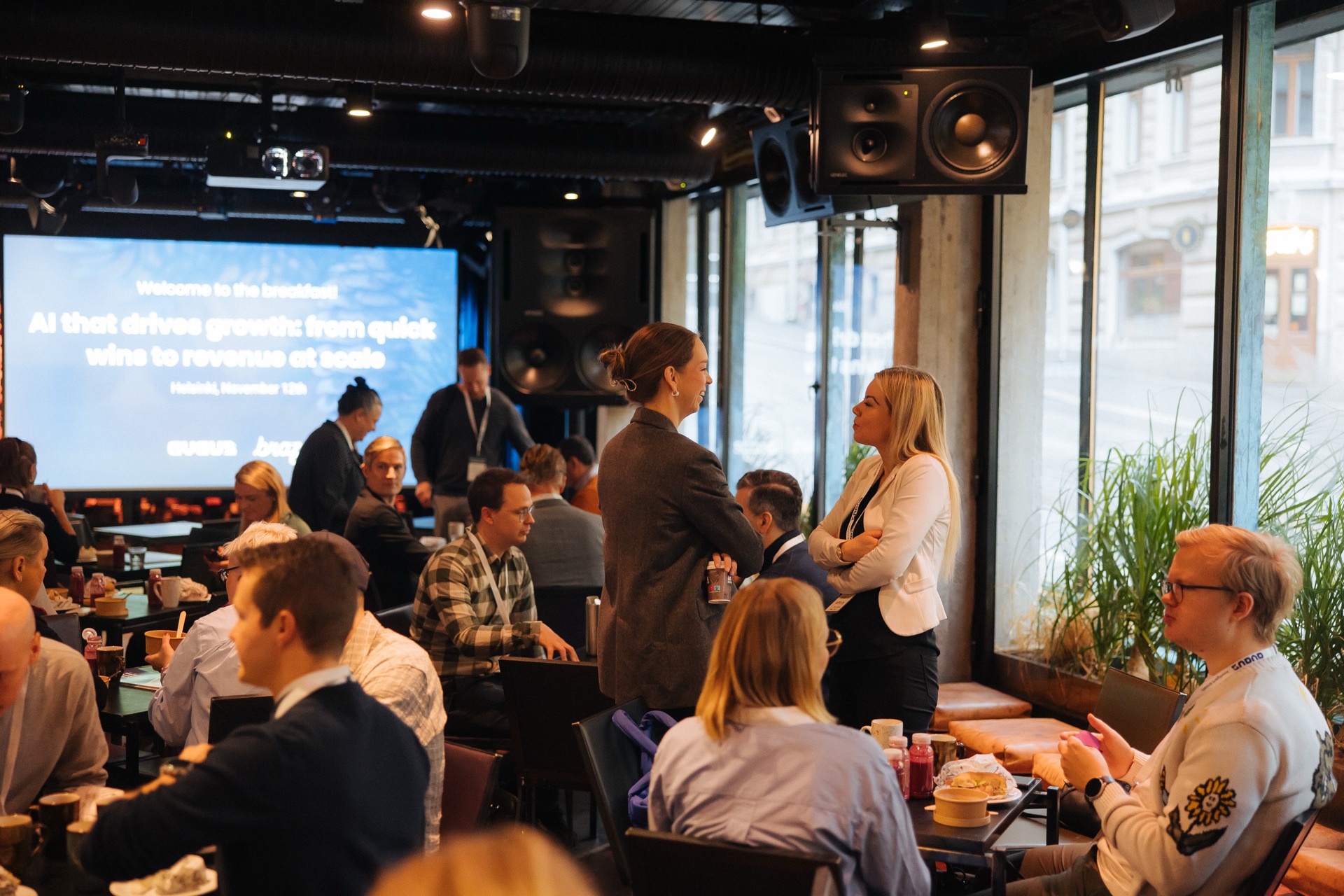
On November 12, more than 70 commercial, marketing and data leaders joined us at G Livelab in Helsinki for “AI that drives growth: from quick wins to revenue at scale”, co-hosted by Avaus and our partner Braze. Speakers from McDonald’s Nordics, Alleima, Schibsted, Braze and Avaus shared what has worked inside their own companies. This blog covers the morning.
We opened with a show of hands. Almost everyone in the room had an AI pilot running, and almost everyone said it had delivered good results. Then we asked how many had been invited to present those results to their CEO or board. Only a few hands stayed up. That gap between a pilot that works and a result the board cares about was the theme of the morning.
Closing it is mostly an organizational job: in our experience, about 20% of the results from AI come from the technical foundation and 80% from the operating model.
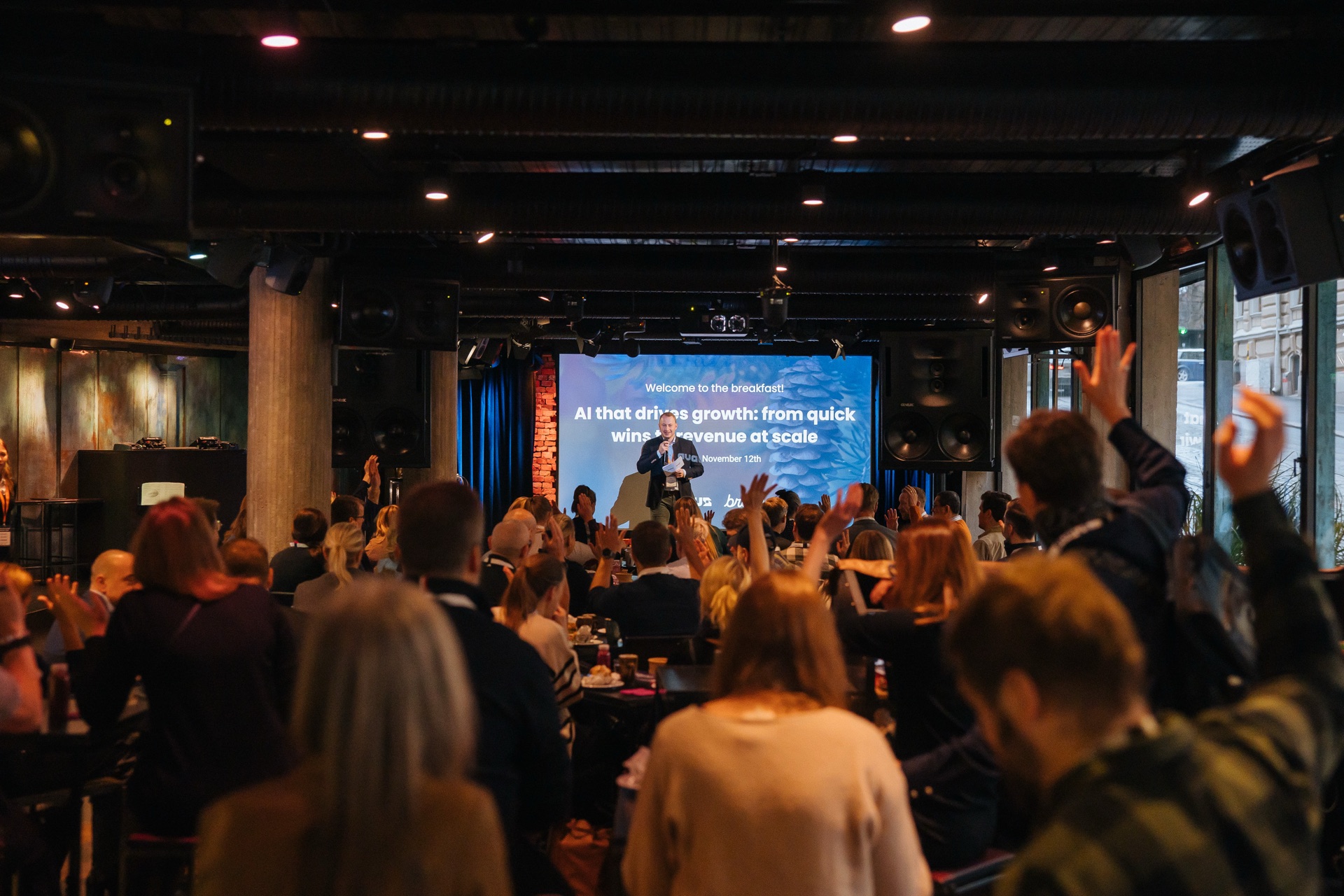
Most of the room had an AI pilot running. All photos from the event credited to: Henri Juvonen
Ilona Vigren (Avaus): most of the result comes from how you work
Ilona Vigren, Director of Strategic Business Development at Avaus, has spent almost 15 years helping management teams make data and AI investments pay off. In her experience, what separates the companies that succeed from the ones that fail is how the leadership team works, and almost never the technology.
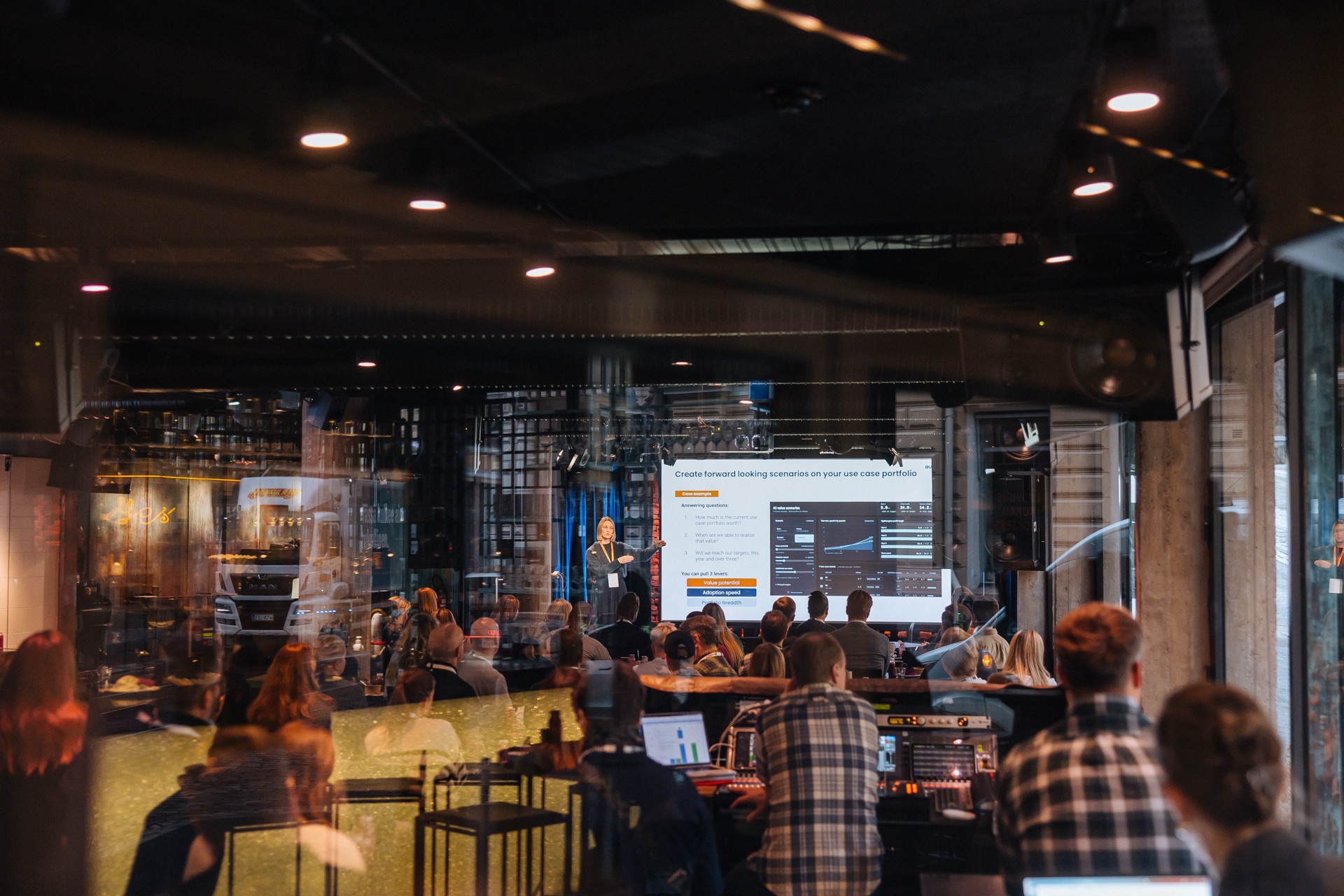
Ilona Vigren, Avaus.
She described AI transformation as three leaps.
The first is getting started, which takes the most energy. The second comes when you start changing core processes instead of adding tools on top. The third goes beyond what you planned for, and is hard to see from the start. Underneath all three, the company builds the organizational capability to take the next leap, which quick wins alone never build.
She shared a line from the AI playbook that the micromobility company Voi has published: “The tech mattered, the operating model mattered more.”
On the technical 20%, her advice was to build slice by slice, use case by use case, with Data-Algo-Action as the formula for every use case. One travel client built its entire foundation in the first year through 30 use cases, which were already creating value by the end of that year. She also asked the room to stop leaving measurement until last:
“Don’t put that on the back burner, put it on the front of your development.”
Without it, nobody gets invited to the board.
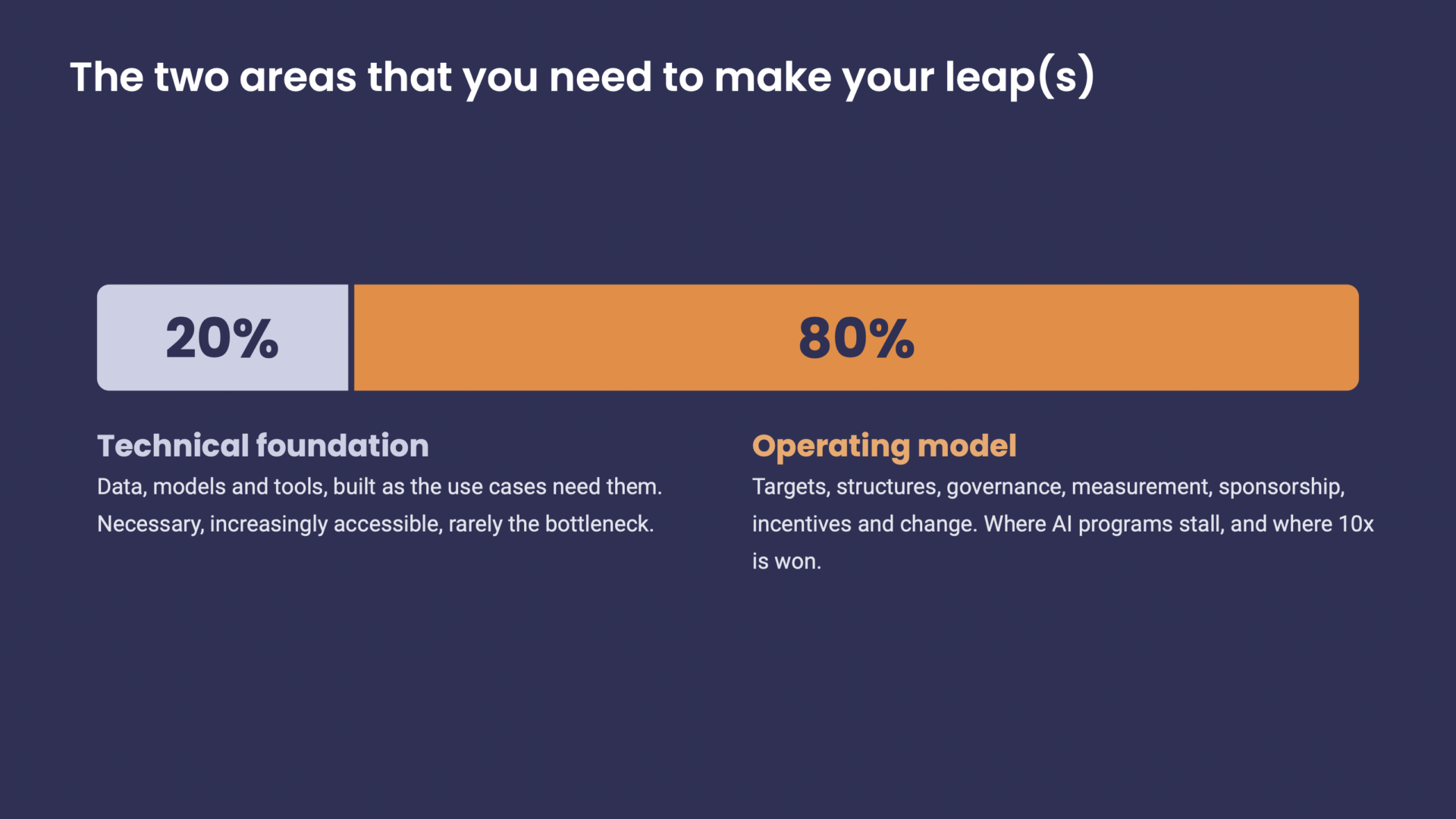
About 20% of the results come from the technical foundation and 80% from the operating model. Slide: Ilona Vigren, Avaus.
The other 80% is the operating model, which we describe in eight dimensions, from targets and strategies to structures, governance, measurement and change management. Ilona showed two parts in practice:
- Connect the pilots to the targets. At a telco client, every use case traces back through a strategy and a value driver, such as retention, to a commercial target. That chain is what lets leadership see what the work is worth and pull levers on scope and speed.
- Make leaders own the change. At another client, a change management workshop put the “elephants” on the table, and every member of the strategic steering group now owns one. A change lead facilitates, but the leadership team does the work. Otherwise, as Ilona put it, change gets glued on top.
Her closing question was for the room: look at your calendar and check whether your time goes to the 80% that creates the results. You can map where your own organization stands with our operating model assessment.
Mikko Poutanen (McDonald’s): build for reuse, and AI can use it too
Mikko Poutanen, Digital Products and Services Lead at McDonald’s Nordics, said the problem his team set out to solve was scale. Four Nordic markets produced similar campaigns in four different ways, and spent a lot of time repeating the same tasks.
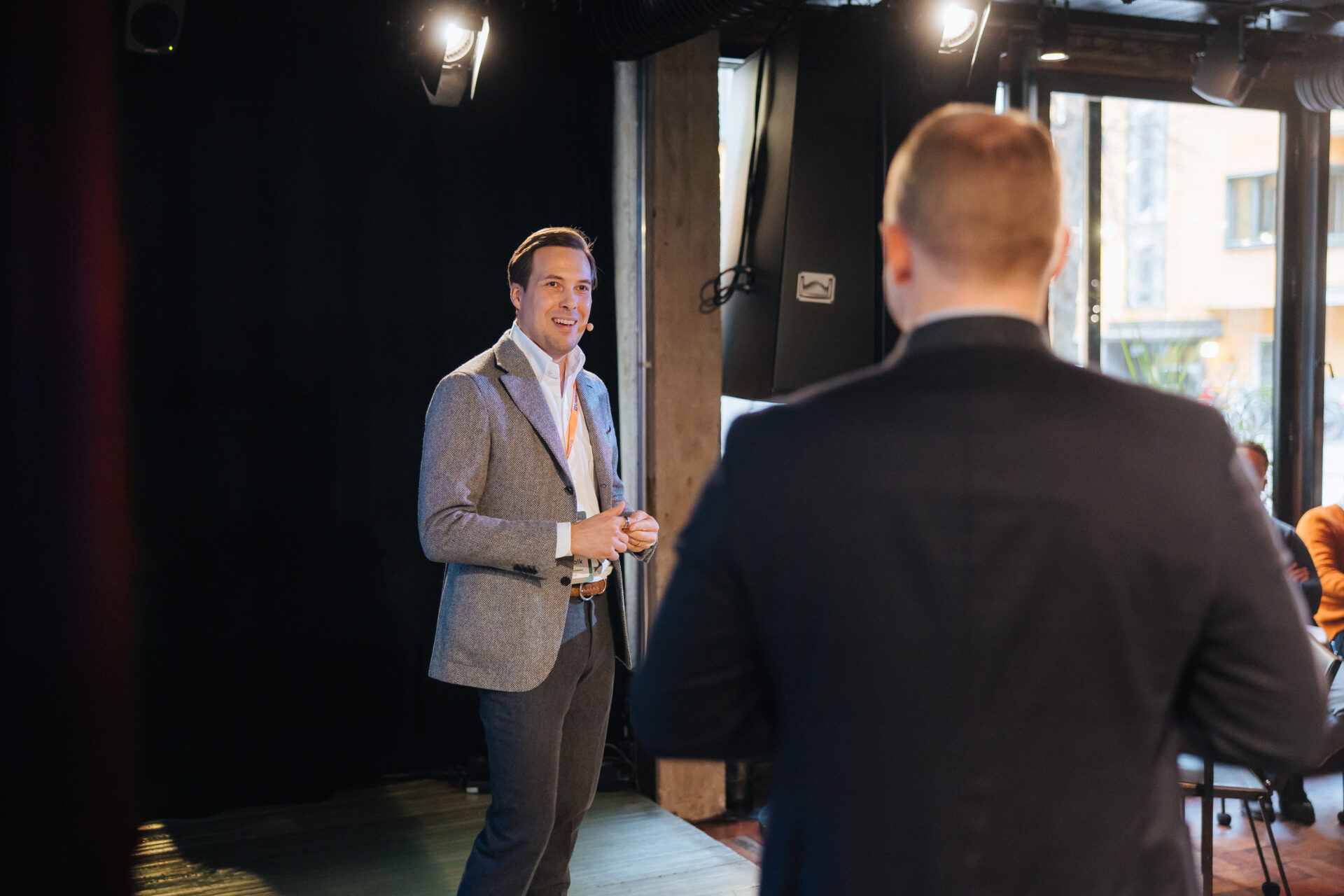
Mikko Poutanen, Digital Products and Services Lead at McDonald’s Nordics.
The answer was a shared Nordic content hub. Images had to work in every market, and every asset needed explicit tags and metadata, so that systems could find, combine and distribute content without a person doing it by hand.
“We needed to see content as data,” Mikko said.
The work moved in steps: first the tools, then the first use cases, then new processes, and finally automation. Each step created value on its own. Mikko’s main point was that the foundation stopped being a project and became a reusable capability. The same structured product and campaign data now lets AI write copy that follows the brand guidelines and channel requirements, instead of starting from a blank prompt.
His advice was to design for reuse, so the data serves many tasks instead of one, and to talk to leadership about outcomes rather than about the foundation underneath.
Håkan Carlsson (Alleima): prove one use case, then build the foundation
Håkan Carlsson, Senior Business Process Specialist at Alleima, spoke in conversation with Emmi Davidson, Senior Consultant at Avaus.
Alleima, a Swedish maker of advanced stainless steel with about 6,800 employees and sales in 80 markets, is a relationship-driven company that found its customers increasingly research and compare online.
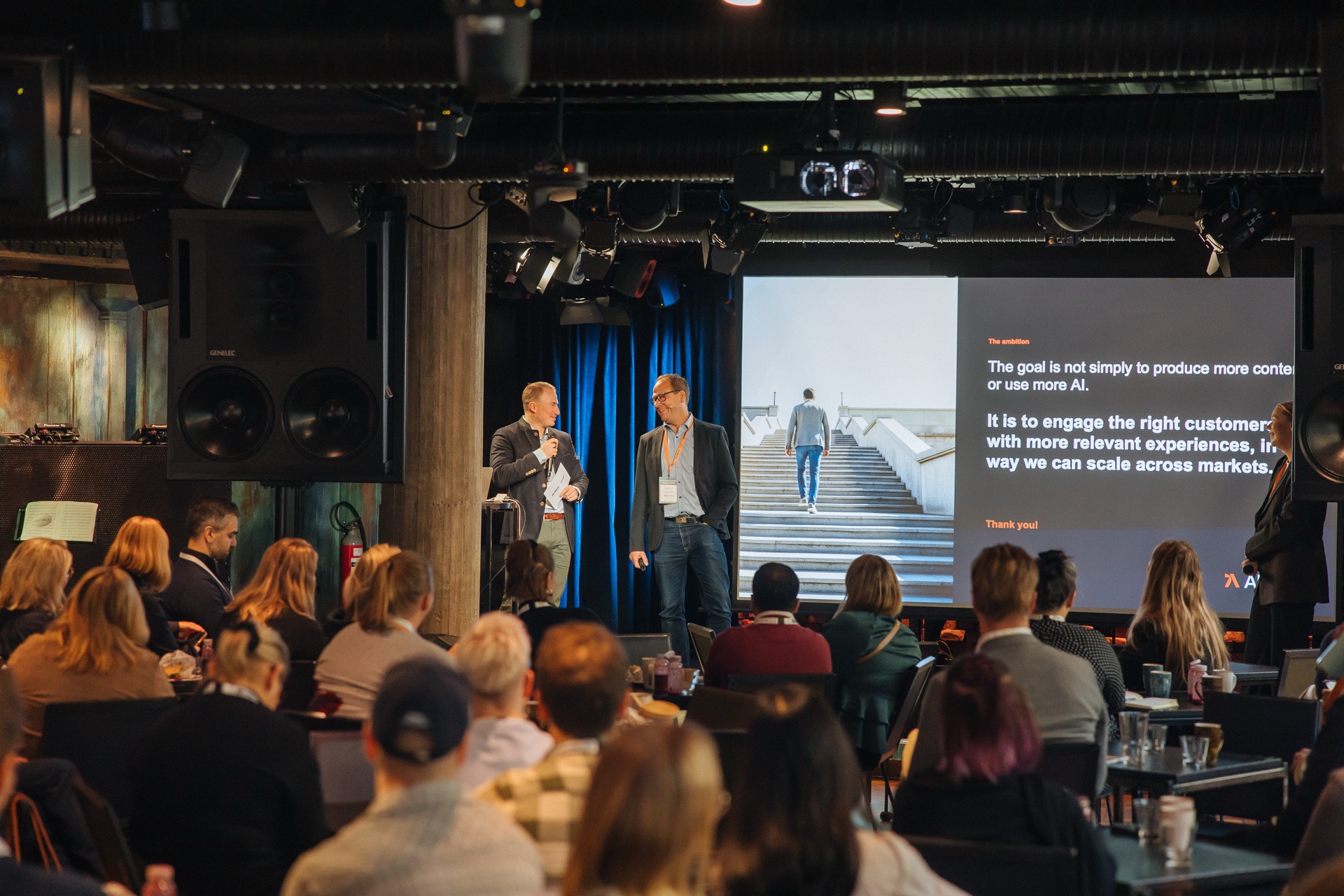
Håkan Carlsson, Senior Business Process Specialist at Alleima, on stage.
Instead of starting with tools, Alleima began with a pre-study. “We are experts in steel,” Håkan said, and the team needed to understand what new ways of working and AI could bring.
The biggest finding was that content was the bottleneck. Alleima had plenty of it, mostly technical data sheets in the wrong format for digital channels.
That led to two streams. Digital lead generation follows the REANS model (reach, engage, activate, nurture and sell), from targeted ads through industry landing pages and a total cost of ownership calculator to email nurturing and a handover to sales.
The content engine turns one existing piece of content into channel-ready output, such as LinkedIn ads, nurture emails, web pages and localized versions. Its core is a set of AI skills, the written instructions for what content Alleima needs and which brand rules to follow, and a person reviews everything before it goes live. One early win was producing content for Alleima’s Chinese website, which the local team had struggled to keep up to date from the global site.
Mikko had started with the foundation. Alleima did the opposite, and Håkan called that the right choice for a traditional industrial company:
“Seeing is believing.”
The pilots in APAC and one business unit have generated leads and opportunities, with sales cycles that can run for years.
Next year, Alleima will build the foundation to scale, and move its AI skills into Microsoft Copilot so marketers can use them in conversation.
We explore the same trade-off in build at scale or experiment first.
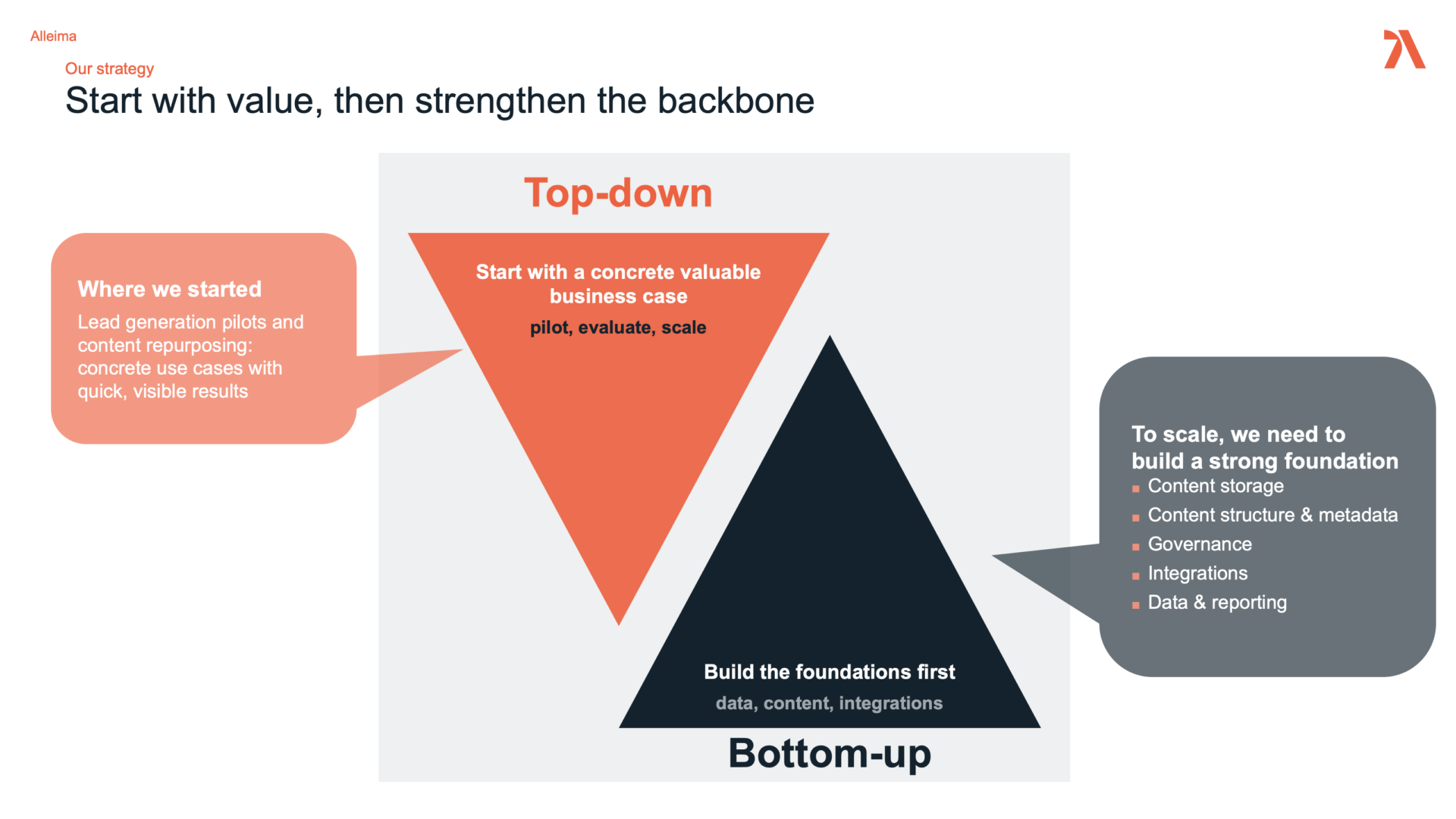
Alleima started with value and is now strengthening the backbone. Slide: Håkan Carlsson, Alleima.
Erik Gundersen (Schibsted) and Arash Jasseb (Braze): break the big goal into actions a model can learn from
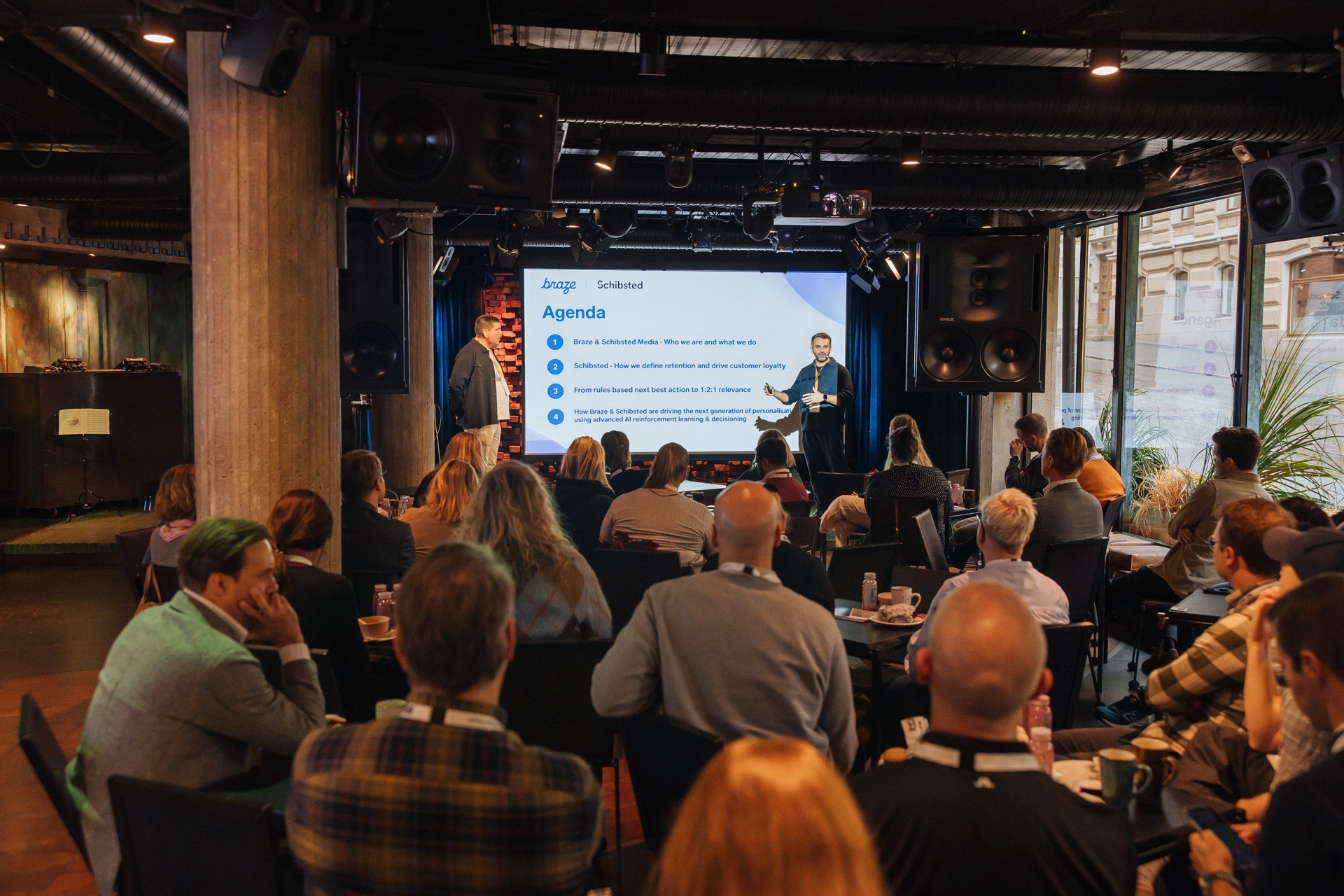
Arash Jasseb of Braze and Erik Gundersen of Schibsted.
Arash Jasseb, Senior Account Executive at Braze, started from a familiar promise:
“One-to-one relevance at scale has long been the dream of a lifecycle marketeer.”
However detailed a segment is, segment-based marketing still targets groups, not people. AI decisioning uses reinforcement learning to choose the offer, message, channel and timing for each person, and keeps learning from every response.
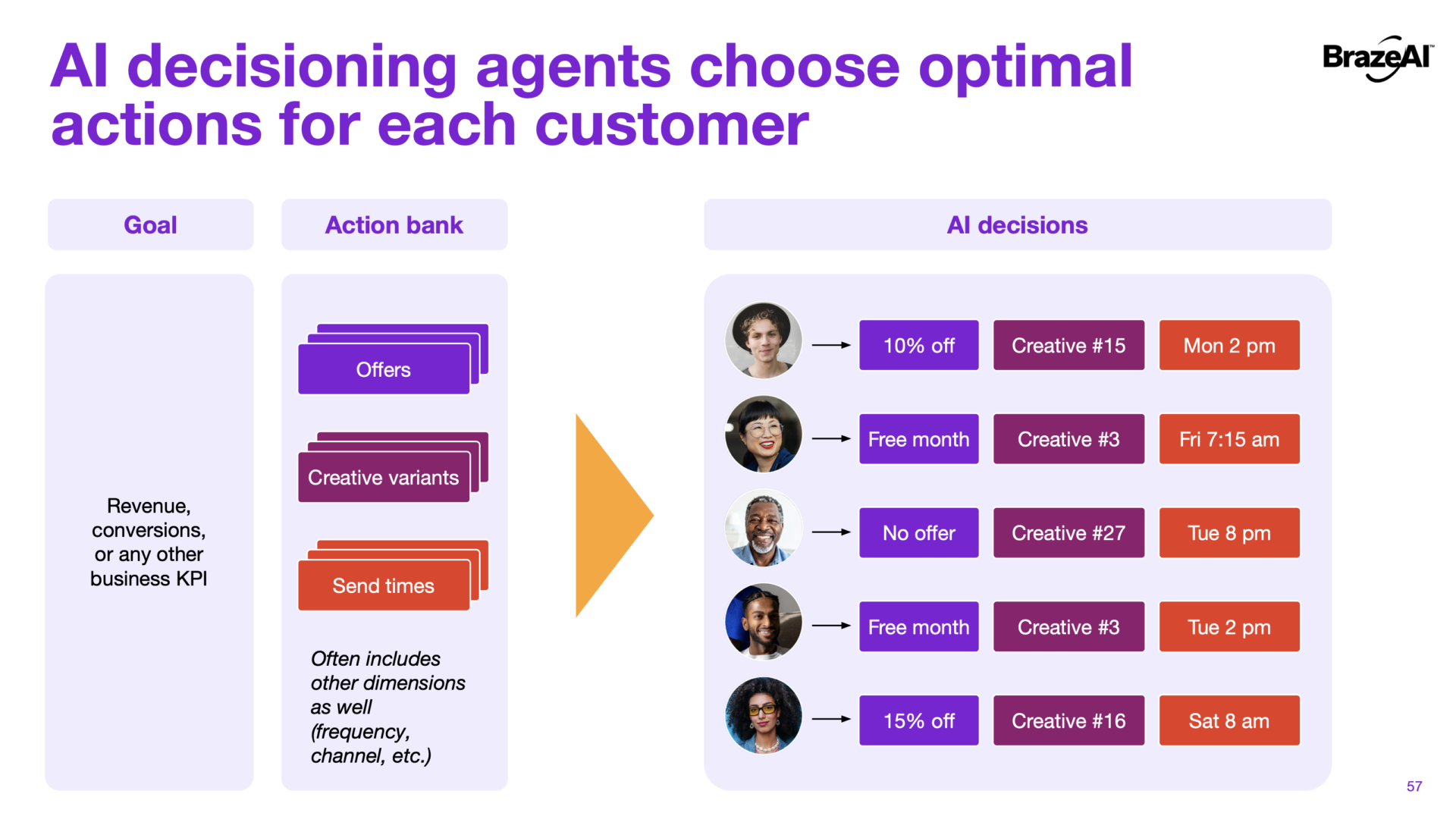
AI decisioning picks the offer, creative and timing for each customer. Slide: Braze.
Erik Gundersen, Senior Customer Lifecycle Specialist and AI Tech Lead at Schibsted, showed what it takes to go live.
Schibsted’s seven Nordic news brands send more than 210 million emails a year, a volume where one-to-one relevance can’t be built by hand. Its own tests already showed the value: an interest model for one podcast lifted click rates by 72% and listen rates by 55%.
Schibsted counts a subscriber as loyal after 100 days, which is too long for a model to learn from. Even the first full-price renewal arrives 30 to 45 days in, as one yes or no a month. So the team trains the model on high-value actions that show up within 24 to 48 hours: app sessions, newsletters, article reads and podcast plays. Each action runs in its own randomized lane, measured against a silent holdout group, so the team can prove what each action is worth.
The second job was the action bank, the menu of content the model chooses from.
“The engine is only as good as its menu,” Erik said.
Schibsted turned 69 one-off emails into 340 reusable modules and 58 new content blocks, with AI agents doing the groundwork. Their rule was “Agents build and flag. People decide.”
The estimated build effort for all seven brands fell from about 200 hours to about 32. Before signing anything, Schibsted and Braze built a business case together with low, medium and high scenarios.
Erik closed with five things he would tell anyone making this bet:
- Content supply is the bottleneck. With too few actions, the engine has nothing to choose between.
- Your real KPI is too slow to learn from, so train on faster engagement signals.
- Personalization exposes your data debt. Audit every attribute, event and rule before you build.
- Correlation flatters your campaigns. Loyal readers install the app anyway, so use a holdout from day one. Arash recommended at least 10%.
- Use AI on the groundwork, too. Agents build and test, and people make every call.
For more on the content side, see our post on personalization at scale with content automation.
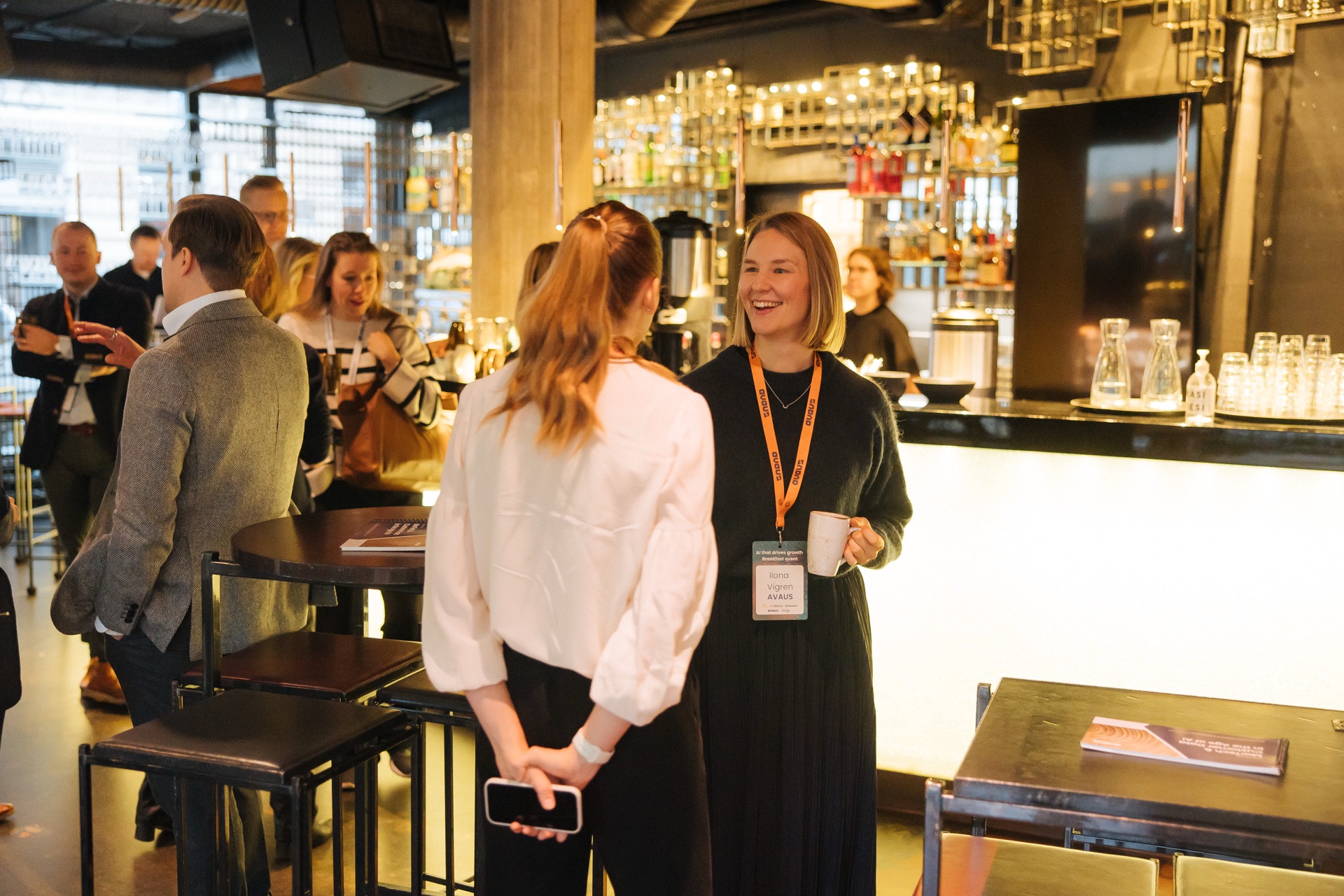
Breakfast and conversations at G Livelab.
What the four talks had in common
Each speaker found the same constraint from a different direction. McDonald’s made its content reusable through metadata, Alleima made its technical content reusable through AI skills, and Schibsted made its emails reusable as content blocks.
In all three, AI only scaled once the content and data underneath were structured for reuse, and in all three, a person still checks the output.
The order differed. McDonald’s built the foundation first and found that AI could use it. Alleima proved the value first so the organization would fund the foundation. Both work, and both need what Ilona described: targets that connect the use cases to the business, measurement from day one, and leaders who own the change.
Four things to take away
- About 20% of the results from AI come from the technical foundation and 80% from the operating model. Check where your leadership team spends its time.
- Build use case by use case across the whole stack, and put measurement first.
- Treat content as data. Metadata and reusable blocks are what let AI produce at scale.
- When the business goal is too slow for a model to learn from, break it into the actions that predict it, and measure against a holdout group.
Common questions
Why do AI pilots fail to scale?
Most AI pilots are not connected to the company’s commercial targets, and the organization around them does not change. In our experience, about 20% of the results come from the technical foundation and 80% from the operating model: targets, structures, governance, measurement and change management. Pilots that skip that work stay pilots.
Should you build the data foundation first or start with use cases?
Both orders can work. McDonald’s Nordics built a metadata foundation first and found that AI could use it. Alleima proved value with small pilots first and will build the foundation next. The common rule is to build slice by slice, one use case at a time across the whole stack, instead of a multi-year foundation project with no results along the way.
What is AI decisioning?
AI decisioning uses reinforcement learning to choose the best message, offer, channel and timing for each customer, and keeps learning from every response. It needs a clear goal the model can learn from quickly, a large bank of content to choose from, and a holdout group of at least 10% to measure the real uplift.
Want to work out where AI can grow your revenue?
Our half-day executive workshop in Helsinki on February 11, 2027 brings together a curated group of around ten senior commercial leaders to work through where AI can grow your revenue and what it takes to get there.
Get in touch to learn more
Related reading
- Lessons on AI in B2B sales from the Stockholm breakfast
- From AI experiments to organizational impact: the Helsinki breakfast in May
- Case story: Dustin: commercial AI program
- Case story: Adobe-to-Braze migration for a media company
- Case story: Telia’s path to content automation