On 13 May, we brought together commercial business leaders in Helsinki for a breakfast on AI strategy, operating models, and what it actually takes to move from experimentation to results. Four organisations shared what they have learned so far.
Here is what stayed with us.
Yle: The trajectory was visible, but acting on it was not
Mikael Hindsberg, foresight project lead at Yle, opened with a timeline that started in 2020, two years before ChatGPT made it impossible to ignore. The signal was there, he argued, for anyone scanning the environment: Fin-BERT summarising texts in August 2020, OpenAI Codex building games and data science applications in 2021. Yle’s foresight team saw it. The organisation largely did not, until November 2022, when ChatGPT went viral and ”everybody was in full panic mode”.
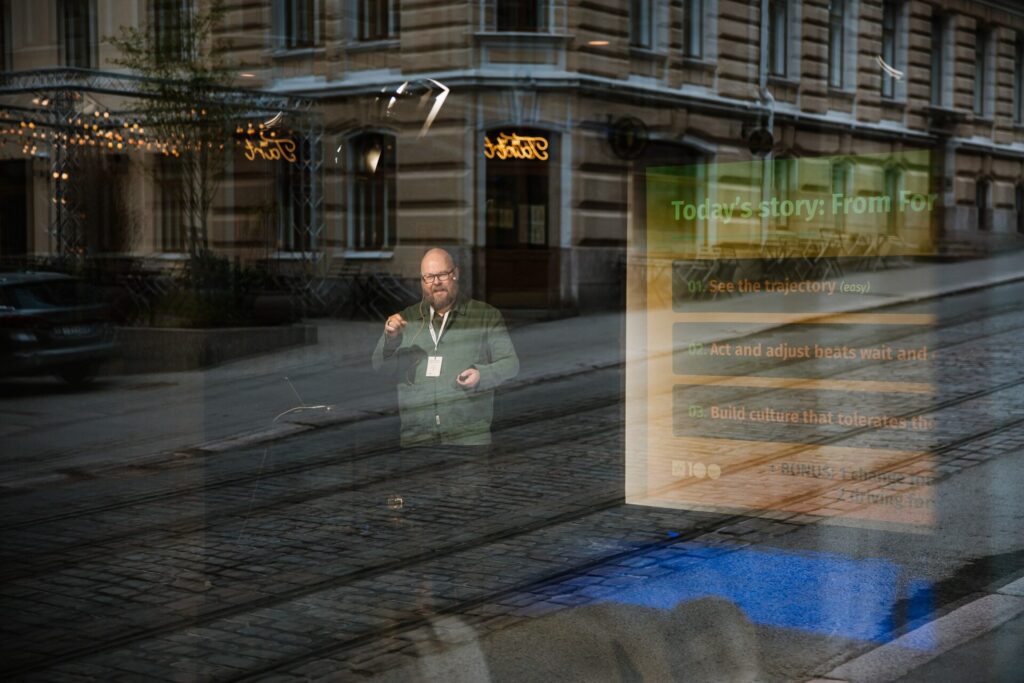
His point was not to boast about early detection. It was to name the real problem: spotting the trajectory is the easy part. Getting an organisation to act before something goes viral is much harder, and building a culture that can tolerate the discomfort of uncertainty is even harder.
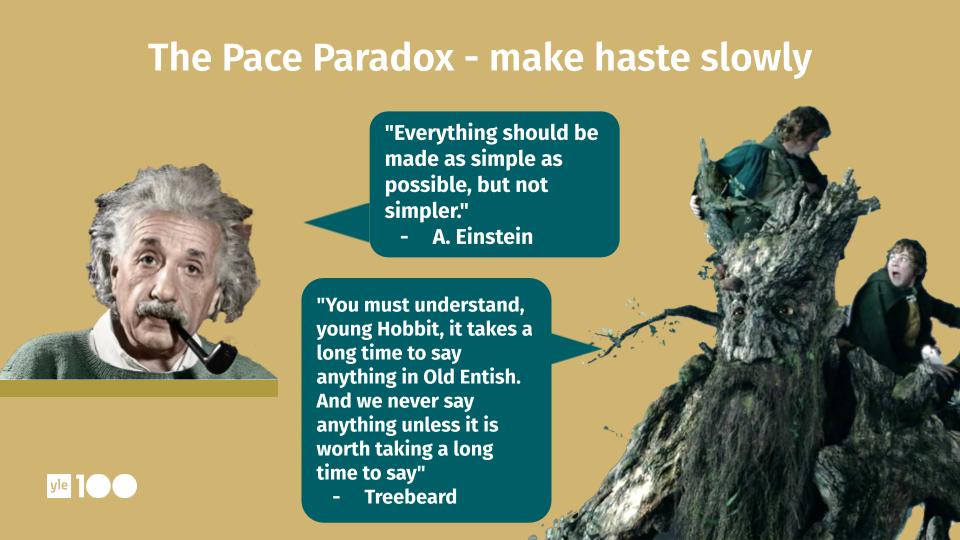
Mikael described Yle’s approach to agent development as “one data, one user, one process at a time.” The organisation has 3,000 people across 3,000 different jobs. Top-down process mapping collapsed under its own complexity. What worked instead was starting small, making tacit knowledge visible, and letting cumulative value build gradually.
For example, when Yle mapped their content development process, they found the data overlapped with what a target group agent would need. So they built that too. That is how compounding starts, one process reveals the next.
He flagged two forces to watch: 1) local models running on-device, which he sees as the next major shift, and 2) growing anti-AI sentiment, which he argues is less about the technology itself and more about deeper political and economic anxiety.
Avaus & AI Finland: Stop the “piiperrys”, start the operating model
Emma Storbacka, CEO of Avaus, and Nico Salmela from AI Finland ran a live working exercise. The audience used AI to generate use cases for their own organisations, then immediately used AI to produce a frank assessment of why those same organisations would probably fail to capture the value. The responses from the room were familiar: data silos, leadership commitment, wrong KPIs, and decision speed.
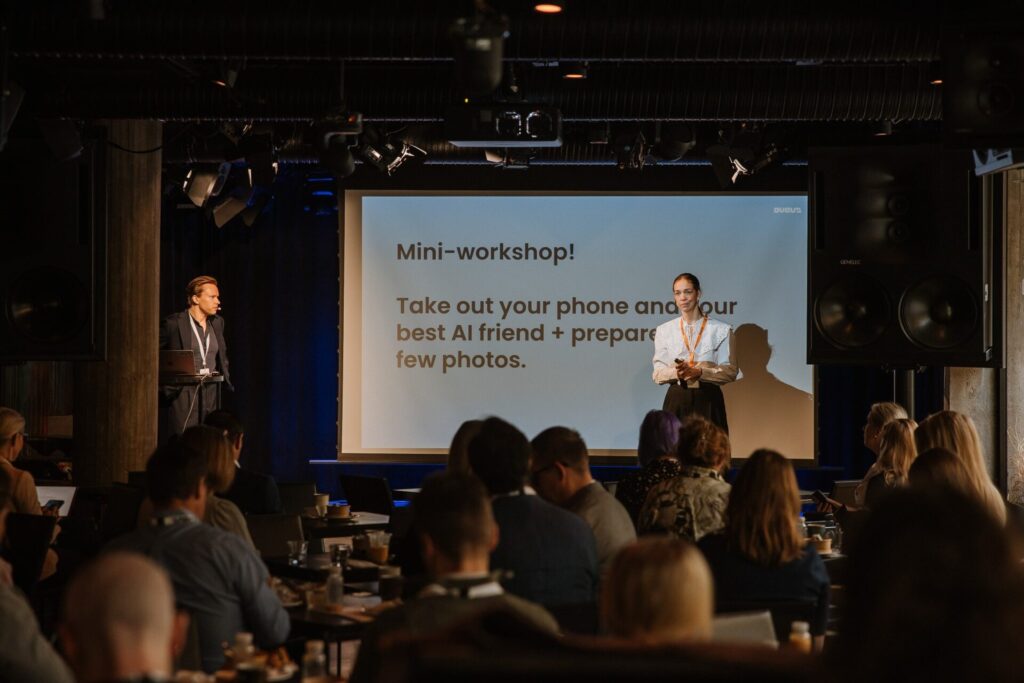
Here is the exercise for you to try yourself:
Open your AI tool of choice, which probably already has some context about your role, your company, and what you sell. Then run these two prompts back to back, the second one only works if you do the first one first.
Prompt 1:
“Given what you know about my work, give me a list of 10 AI use cases that would significantly increase (more than 10x) the value generated for our customers. Give me the results in a table format. Be specific about the action layer, don’t list capabilities. Score the use case on impact and feasibility/effort. Give me a simplified ‘napkin’ business case including annualised business impact and investments needed. Use Avaus methodologies and best practices.”
Prompt 2:
“Now based on what you know about our organisation and what typically is difficult in implementing AI use cases, list the most likely reasons why our organisation wouldn’t succeed in capturing that 10x value. Rate how likely you think it is that these reasons would apply for us, based on the context you have about our specific strengths and weaknesses. Give me a short summary and be brutally honest.”
The second prompt tends to land harder. Share the output with a colleague and discuss if it feels accurate.
Emma argued that most management teams are still asking the wrong question. “What can we do with AI?” leads to what we call piiperrys (Finnish slang for activity that looks like progress but produces none), pilots and experiments that generate activity but not commercial results. The right question is “What should we be doing?” That question, answered honestly, leads to growth.
3 misconceptions about AI that are slowing organisations down
Emma sees three misconceptions repeatedly in management teams.
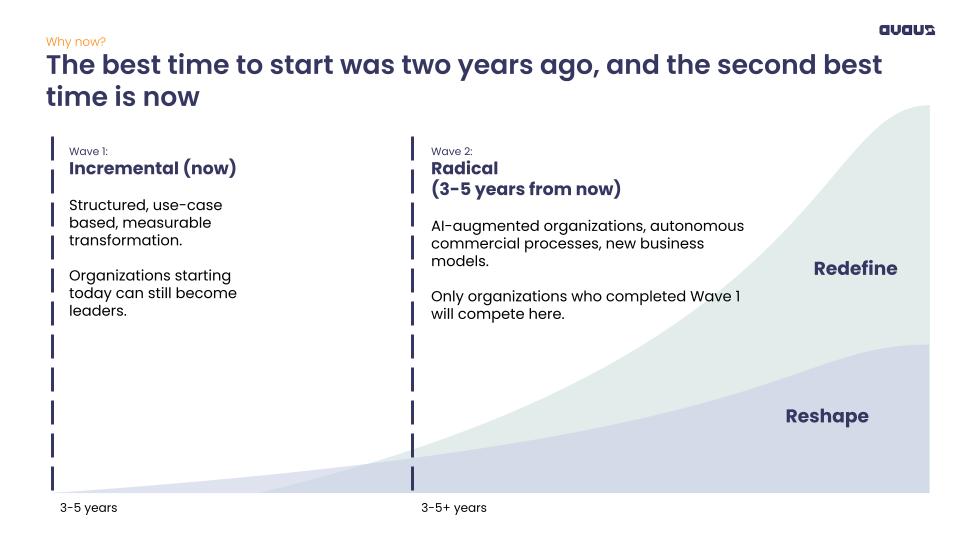
The first is waiting for the technology to mature. The problem with that logic is that the technology is not what needs to develop, the organisation is. The incremental first wave, which can feel slow and unremarkable for three to five years, is the only path to the more radical second wave. Organisations that skip it will not be able to redefine how they operate when the time comes.
The second misconception is treating AI as a cost-saving vehicle. Emma described a dinner conversation with a Swedish bank board member who could not conceive of AI as a growth driver. In the current economic climate, cost savings feel more intuitive. But if AI lets you do things ten or a hundred times better, the right frame is growth, not efficiency.
About the third misconception she stated this:
“If you’re spending more time talking about technology than about the operating model and your organisation, you are going to fail, because that is not the hard part.”
She described the model Avaus sees working: a growing portfolio of use cases on one side, paired with a new operating model on the other. Neither works without the other. And with agentic AI now shifting the ratio of what a small team can achieve, the operating model question has become more pressing, not less.
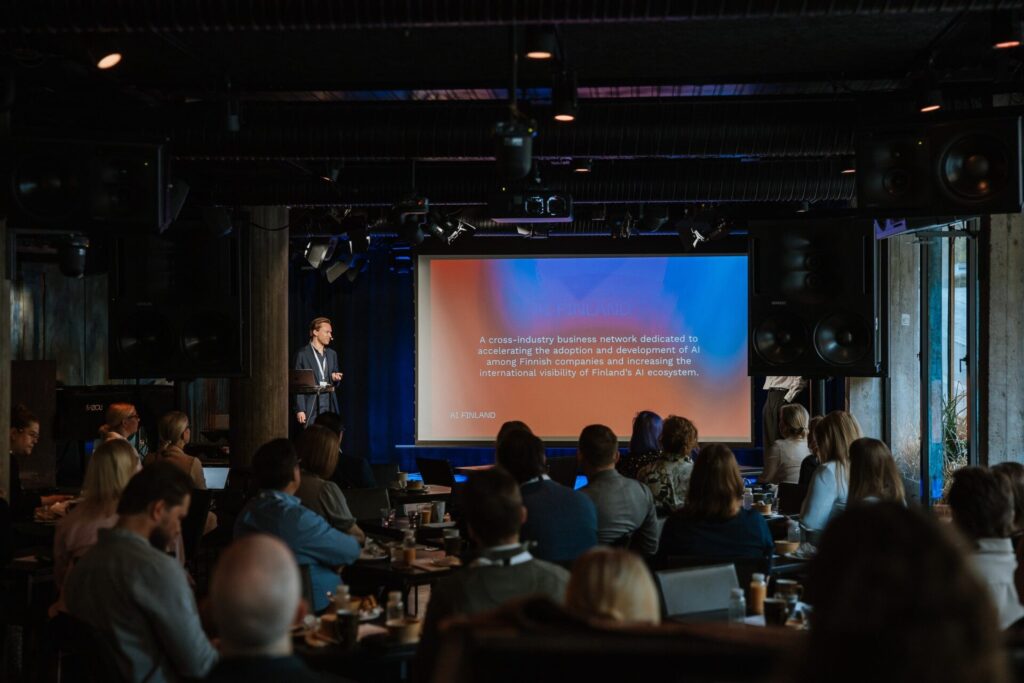
Nico Salmela outlined the AI1000, a programme run by AI Finland together with partners, including Avaus, which has trained the top management of over 1,000 Finnish companies through a 2+4 hour format. The most consistent feedback from participants: the most valuable part was not the content. It was being forced to sit together, align on where the organisation actually stands, and discuss what to do next.
Emma added a phrase she had picked up from a conversation with Mikael who spoke earlier, alongside technical debt and emotional debt, there is now discussion debt:
“We’re not spending enough time actually sitting down and talking.”
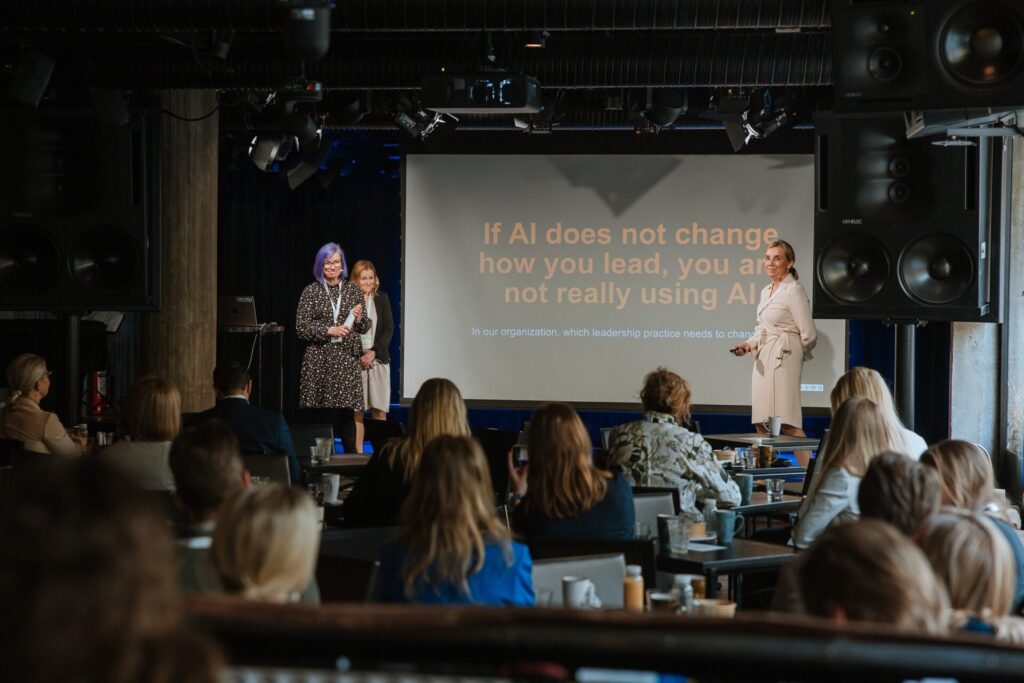
Sanoma B2B: If AI does not change how you lead, you are not really using AI
Three leaders from Sanoma B2B took the stage together, deliberately. Teea Björklund (VP Sales & Marketing), Jaana Tynys (Director, Digital Sales Excellence) and Jaana Tanskanen (Technology Director) structured their session around a principle they have learned through about a year and a half of AI transformation work: this is never a one-role effort.
They organised their learnings across four dimensions: value, design, governance, and people and culture.
On value, the message was to start with the business and work backwards. Sanoma B2B chose a clear focus: growing the SME segment. That focus shaped which use cases they built and which KPI they rallied around. After several iterations, they landed on customer-facing time as the key metric, tracking it in Power BI visible to the whole organisation. Comparing the pilot group against other teams, they saw more time with customers, which translated into more new customer acquisitions.
On design, Sanoma B2B made a significant structural decision a year ago: moving from a functional organisation to roughly 20-25 cross-functional, multi-skilled teams organised across five domains. The shift is still ongoing and not without difficulty, Jaana Tynys acknowledged. Roles and competencies are blurring. A “competence game plan” is being built to track what future skills look like across each role. In parallel, they built an “AI game buddy” narrative for the SME sales organisation, a story about how the sales rep’s work will change and what AI teammates will support which stages of the process.
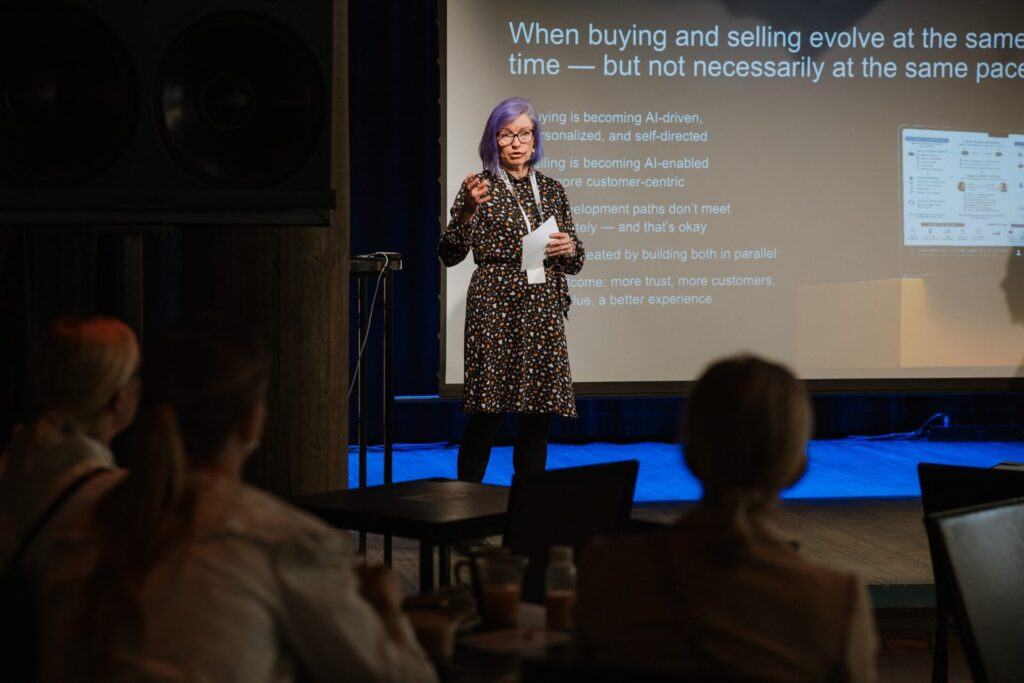
On governance, Jaana Tanskanen named the decision that leaders need to make explicitly: where does automation drive scale, and where does human judgement differentiate? She also pointed out that the EU AI Act adds a new layer of operational complexity: companies now need to legally justify where automation ends and human judgement begins, turning what was previously a strategic choice into a compliance requirement as well.
On people and culture, Teea Björklund delivered the line that has stayed with us since:
“AI transformation doesn’t fail at the top or the bottom. It fails in the middle.”
A study she referenced suggests managers spend around 40% of their time on firefighting and administrative work, leaving perhaps 10% for developing their teams. If middle management does not understand the vision, does not have the time to act on it, and does not feel ownership of the transformation, the programme stalls there. Her advice: put disproportionate focus on middle management.
The personal takeaways from all three were worth noting. Teea: define a bold, measurable AI vision, then do not just sponsor it, learn it and use it yourself. Jaana Tynys: trust the process, and trust that doing something two or three times is how you find what actually works. Jaana Tanskanen: the biggest shift in AI leadership is not knowing everything, it is asking better questions and being willing to show that it is acceptable to fail and try again.
Ericsson: No standardisation means no scalable AI
Anna-Kaisa Valakari, Strategic Operations Director for Marketing at Ericsson, closed the morning with one of the more concrete case studies of the day: how you build an AI-native marketing operating model across 600+ marketers in eight business units around the world.
Her framing was straightforward. Ericsson had AI pilot projects working in pockets. The ambition was to build something that operated as an AI-native enterprise, where AI delivered genuine business value, not just interesting experiments.
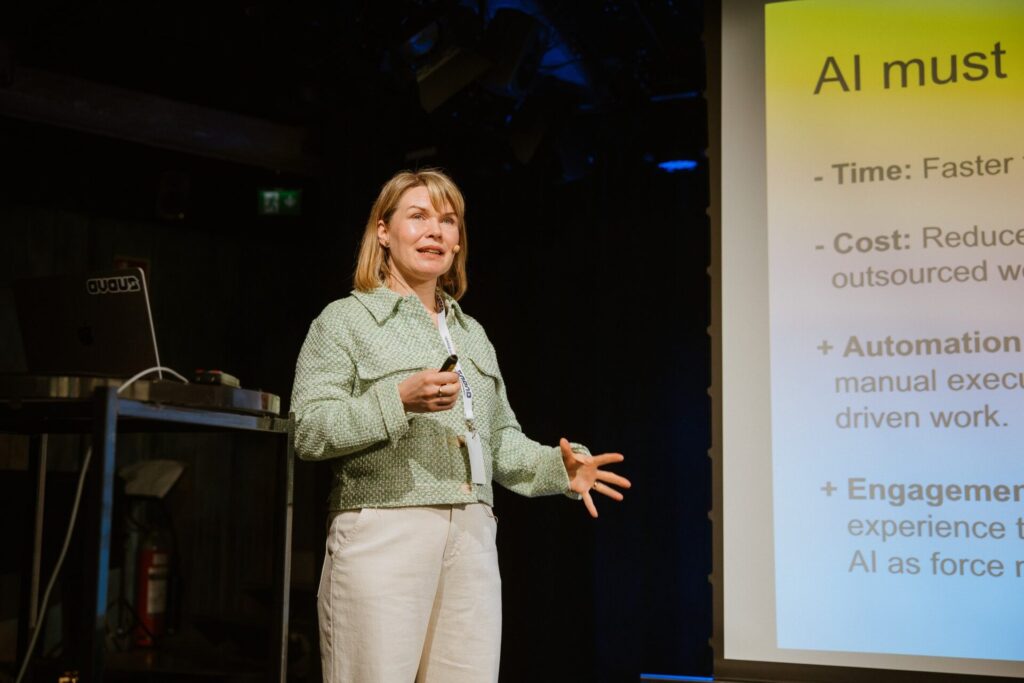
The measures she set: faster time to market, reduced dependency on outsourced work, more automation and accuracy in execution, and improved customer engagement through personalisation.
The barrier she identified: without standardisation, none of this scales. Structured data, unified processes, workflow design that connects systems, and governance that creates consistency across markets, these are the prerequisites. And governance is not optional, it is the architecture that makes everything else possible. Ericsson’s approach includes an AI Taskforce, a strategy steering group, executive buy-in, and AI goals embedded across the organisation.
The practical mechanism is a Central AI Programme with a monthly two-step review: is a new agent request related to a focus workflow, and does it impact the priority tasks? This keeps the development roadmap manageable and prevents the proliferation of hundreds of single-purpose agents. Anna-Kaisa was candid that standardisation creates friction:
“People don’t like it, but we get things done.”
A few examples from production: an email copywriter agent that brought a campaign from two weeks of briefing and discussion down to half a day. Image generation for 5G infrastructure locations, including airports and defence facilities, where traditional photo shoots were impractical or impossible. Translation workflows across hundreds of countries, where AI now handles most of the asset localisation.
On change management, she shared some observations:
- Accept that this is a journey with resistance, peaks of excitement, and valleys of despair before you reach high-performing teams.
- Pair top-down goals with active support rather than waiting for escalations.
- “Crash the party” and join teams at their own campaign level rather than inviting them to workshops about their job processes. When Ericsson’s AI programme tried to engage teams through formal invitations to process mapping sessions, the response was reluctance and withdrawal. When they embedded themselves in live work, the conversations opened up.
The market comparison she ended on is the one that will stay with practitioners longest. When Ericsson updated its AI strategy alongside the Americas market, an executive there was asked how leadership could tell whether teams were using AI to hit their goals. The response:
“What do you mean? Nobody can reach these goals if they don’t use AI.”
The bar was already assumed. The question was not whether to use AI, but how well.
We run a half-day AI leadership workshop for commercial executives, covering value identification, use case prioritisation, operating model readiness, and the pace of implementation. The next sessions are in Helsinki on 30 September and Stockholm on 15 September.
Reach out to get a seat at the workshop
PS. Our next webinar takes place on June 10th. Register now: Why your AI strategy shouldn’t exist – and what to build instead