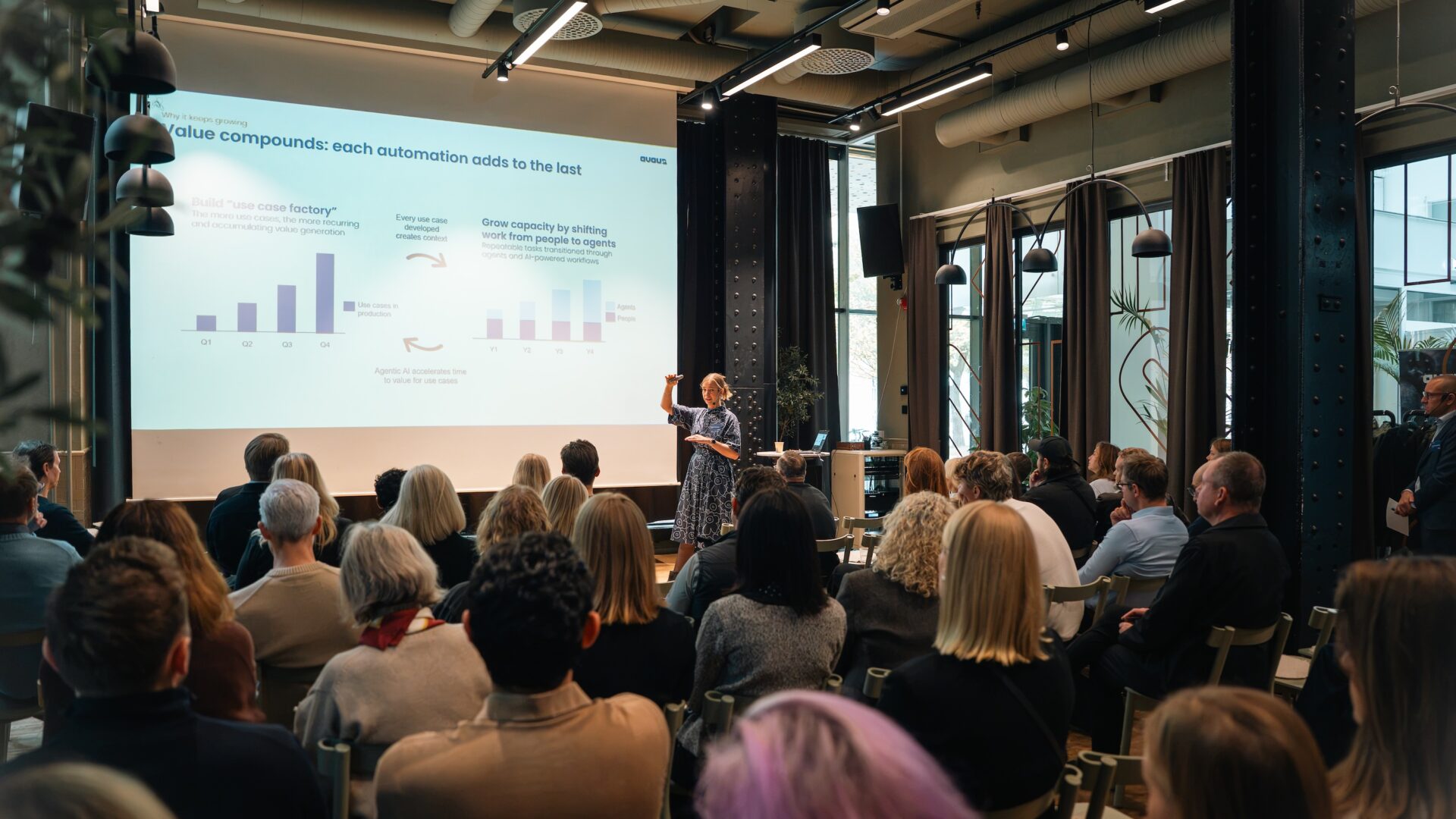
On November 3rd, 45+ commercial leaders gathered at Usine in Stockholm for a morning on AI in B2B sales, co-hosted by Avaus and Njord. On stage, speakers from Njord, Plexigrid, Avaus and Sanoma, and a panel from Candela, Schibsted, Scania and Sanoma, shared how they use data and AI to sell more. This blog covers what was brought up during the morning.
“We talk a lot about 10x, 100x, but the hardest part is to survive your first 1x. This is where most people get stuck.”
That was how Christoffer Agneborg, Head of Strategy at Avaus, opened the morning.
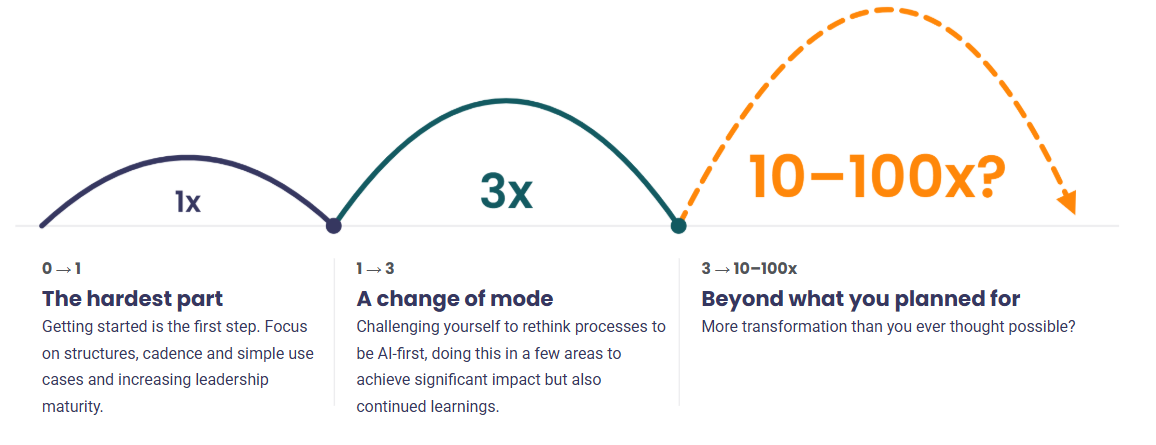
The hardest part is getting to your first 1x. Slide from Christoffer Agneborg, Avaus.
The first 1x is the first real result an AI initiative delivers in the business. The teams that get past it, to one to three times the result, gain the confidence and new ways of working that make the bigger numbers possible. Christoffer asked every speaker the same question: what was hard for you?
We heard the answers through two playbooks. Key account orchestration is for the deals you cannot afford to lose: Njord on how the largest B2B companies grow, and Plexigrid on how a startup won one of the world’s largest grid operators. The long tail is the customers no seller has time to call: Avaus on the recipe for 5 to 7% growth from them, and Sanoma on rebuilding sales for 10,000 SME customers. A panel closed the morning with what the speakers would do differently today.
Christopher Engman (Njord): the biggest B2B companies grow from a few accounts
Christopher Engman, founder of Njord and author of Megadeals, opened with Njord’s analysis of the largest deals at more than 100 Fortune 500 companies. By that analysis, over 90% of B2B companies earn more than 80% of their revenue from 10 to 100 accounts. The biggest grow by winning one or two industries and selling more offerings to the same clients, which is the opposite of the “new segments, new countries” advice most growth talks give.
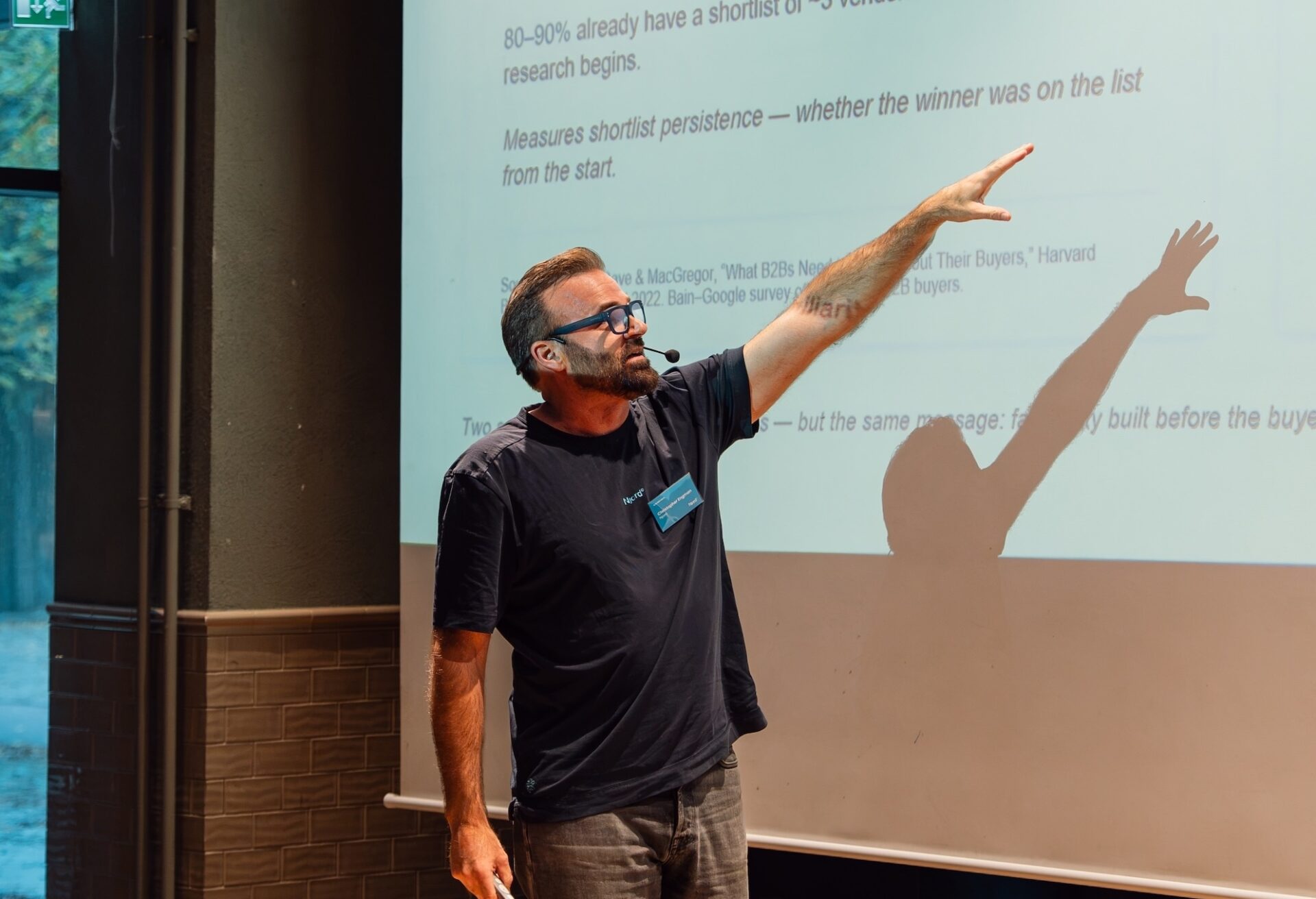
Those few accounts are where selling gets complex. Christopher described three things that change:
- Marketing and sales work in parallel. With seven or more stakeholder groups in one account, or several parties such as distributors and integrators, a step-by-step sales process breaks down. Many threads run at once, from opening the door to growing the client.
- The people who carry the risk decide. Legal, security and compliance have little to gain from saying yes and a lot to lose if it goes wrong. They look for what Njord calls reference market fit: references that look exactly like them.
- A few rainmakers run the biggest accounts. Often one percent of the sales force or less, and in Christopher’s words, “almost always, they suck at CRM.” Njord’s answer is to put more firepower behind them rather than ask them to log more.
His first step was deliberately small: move your LinkedIn advertising budget to targeting the named individuals in your key accounts. Hear more of his thinking in our podcast episode with Christopher.
Linda-Maria Wadman (Plexigrid): make the first purchase feel safe
Linda-Maria Wadman, Chief Commercial Officer at Plexigrid, showed what this looks like from the seller’s side. Plexigrid makes software that frees up capacity in power grids. When she joined in 2021, after 17 years at ABB and Hitachi Energy, she was employee number seven at a university spin-off in northern Spain.
Its customers are regulated utilities, where a purchase needs the engineer, middle management, the board and the CEO. At one point a senior decision maker at the customer questioned how a company that small could be trusted with a large contract.
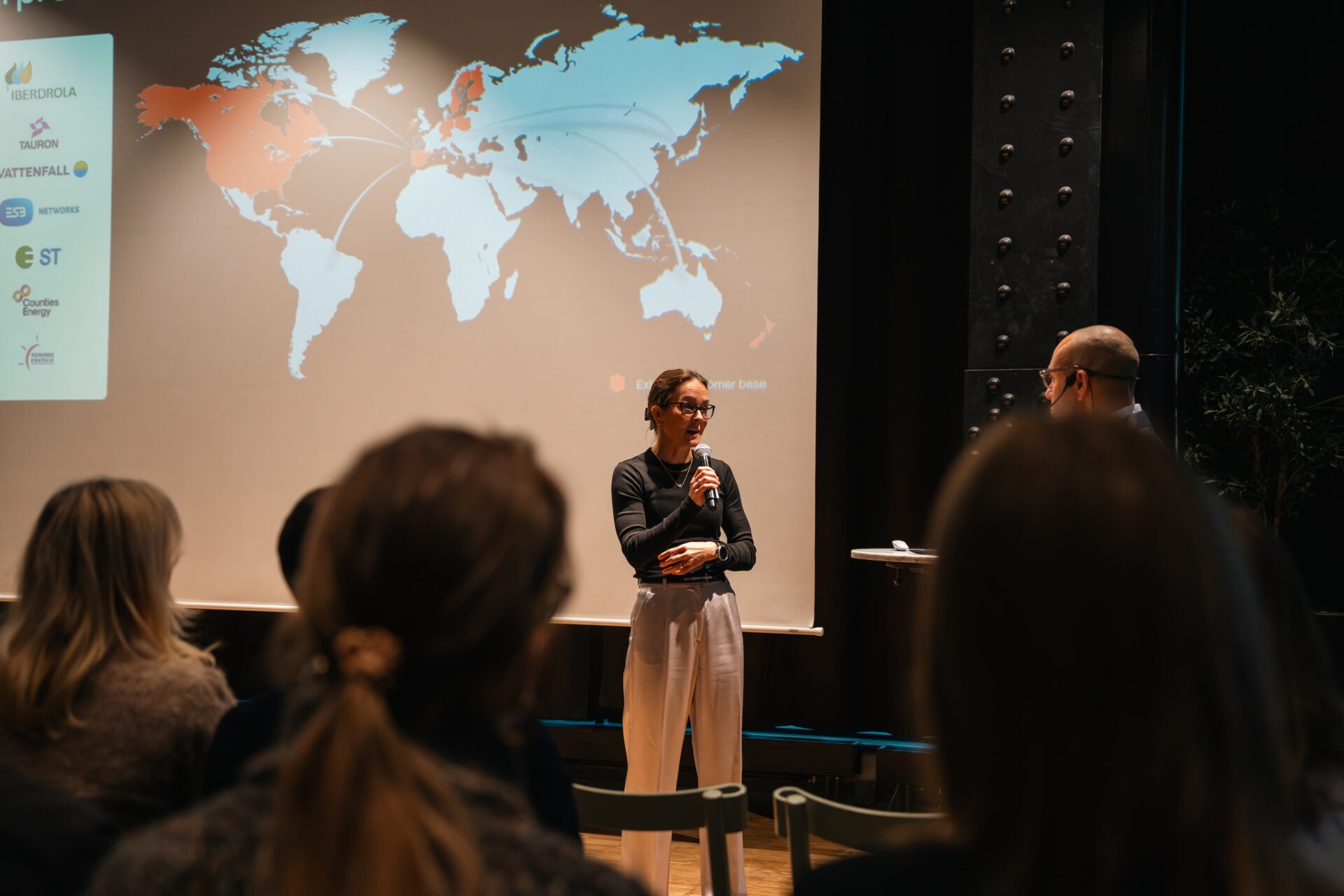
Plexigrid’s answer took four years:
- Find the smallest scope the customer dares to buy. The first project was co-funded innovation work that paid nothing, followed by pilots of around 100,000 euros.
- Sell to the whole organization. Every decision maker and influencer, not only the team running the pilot.
- Be visible where you have nobody. With Njord, Plexigrid ran ads with its own people and local messages in each country. The CEO of a large Australian grid operator got in touch because he saw them everywhere. Plexigrid had no one in Australia.
- Help shape the rules of the game. Plexigrid took part in shaping Spain’s new flexibility regulation, fought to be invited to the tender that followed, and in April 2026 won a five-year contract against the established OEMs.
“Honestly I felt it was almost more like a relief than a win,” Linda-Maria said. With sales cycles of 18 to 24 months, Plexigrid tracks two KPIs, pipeline and sales, and holds every deal to strict criteria at the consideration stage, including a sponsor and a defined procurement path.
Emma Storbacka (Avaus): do 1% better at six basic things
Emma Storbacka, our CEO, turned to the other end of the customer base. Most sales teams use AI to save time: faster emails, less admin. Emma’s argument was to aim it at new sales instead, with a 10x mindset rather than a one-tenth mindset.
The recipe for 5 to 7% incremental growth from the long tail is to do 1% better at six basic things: reaching the right stakeholders, conversion, deal size, purchase frequency, retention and price. “It’s actually about super diligent business management,” Emma said.
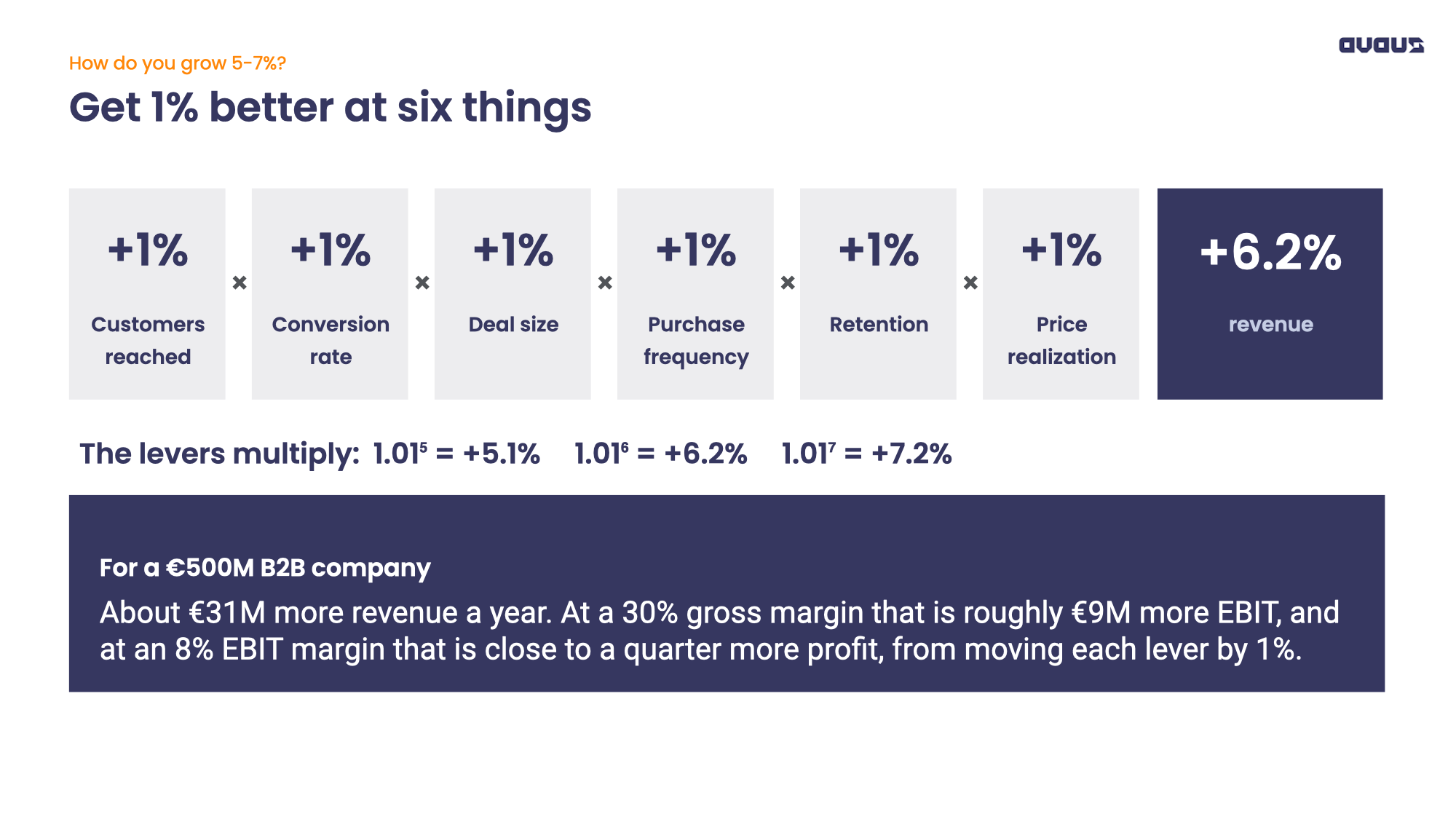
The bigger upside is the customers nobody contacts at all. With AI you can decide at scale who to sell to and what, and build account plans for tens of thousands of customers. Because the long tail has volume, control groups can prove the effect, the way B2C teams do. Emma’s examples ran from simple to advanced:
- Buying signals. For Alleima, Njord shows sales who visited the website and who saw the advertising.
- Predictive offers. For Viking Line, models predict who will travel and what to offer them on board.
- Personalized proof. For Candela, every resort worth selling to gets a landing page with a total cost of ownership calculator set to its own sea distances and diesel use.
Each of these is a use case, which we define as a data-driven and automated process, aimed at impacting a specific business value driver, built from data, algo and action. The value compounds as more use cases run in production, while the investment stays flat.
“The only constraint, it’s not IT, it’s not data, it’s not AI tokens, it’s your organization,” Emma said.
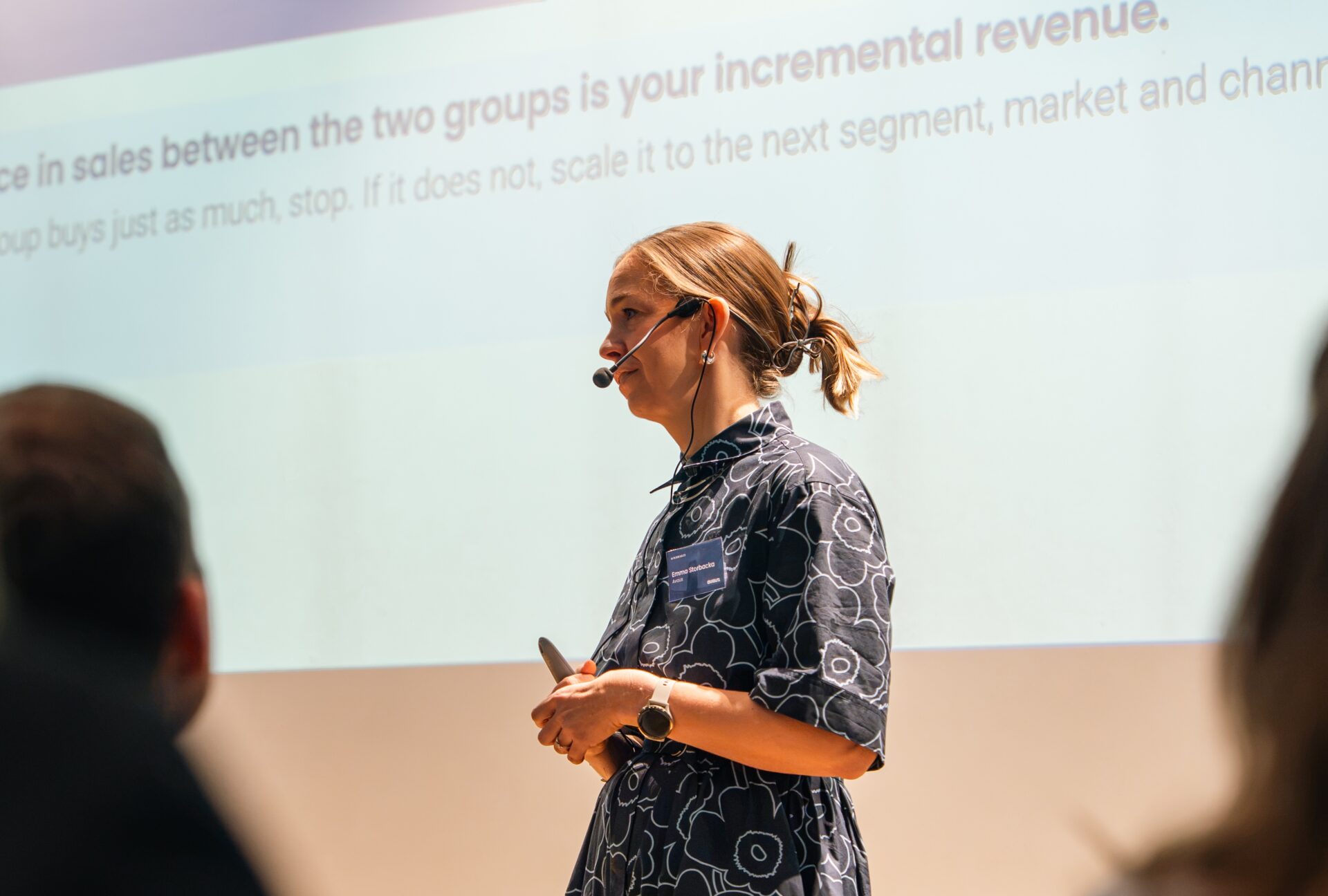
Her advice was to plan for scale from the start instead of running one pilot at a time, and to work on four tracks in parallel: use cases, technical capabilities, the operating model and change management. It also takes senior ownership. At Dustin, where we run a commercial AI program, half the management team spent the day of the event planning use cases for the next three to six months. For worked examples, see our cookbook of 50 use cases or the Use Case Navigator.
Sanoma: one cross-functional team for 10,000 SME customers
Sanoma, Finland’s largest commercial media house, competes with Meta and Google for advertisers’ money every day. Teea Björklund, VP of B2B Sales and Marketing, Jaana Tynys, Director of B2B Digital Sales Excellence, and Jaana Tanskanen, Director of B2B Technology and Data, came as a team on purpose. “AI is never a one role effort,” Teea said.
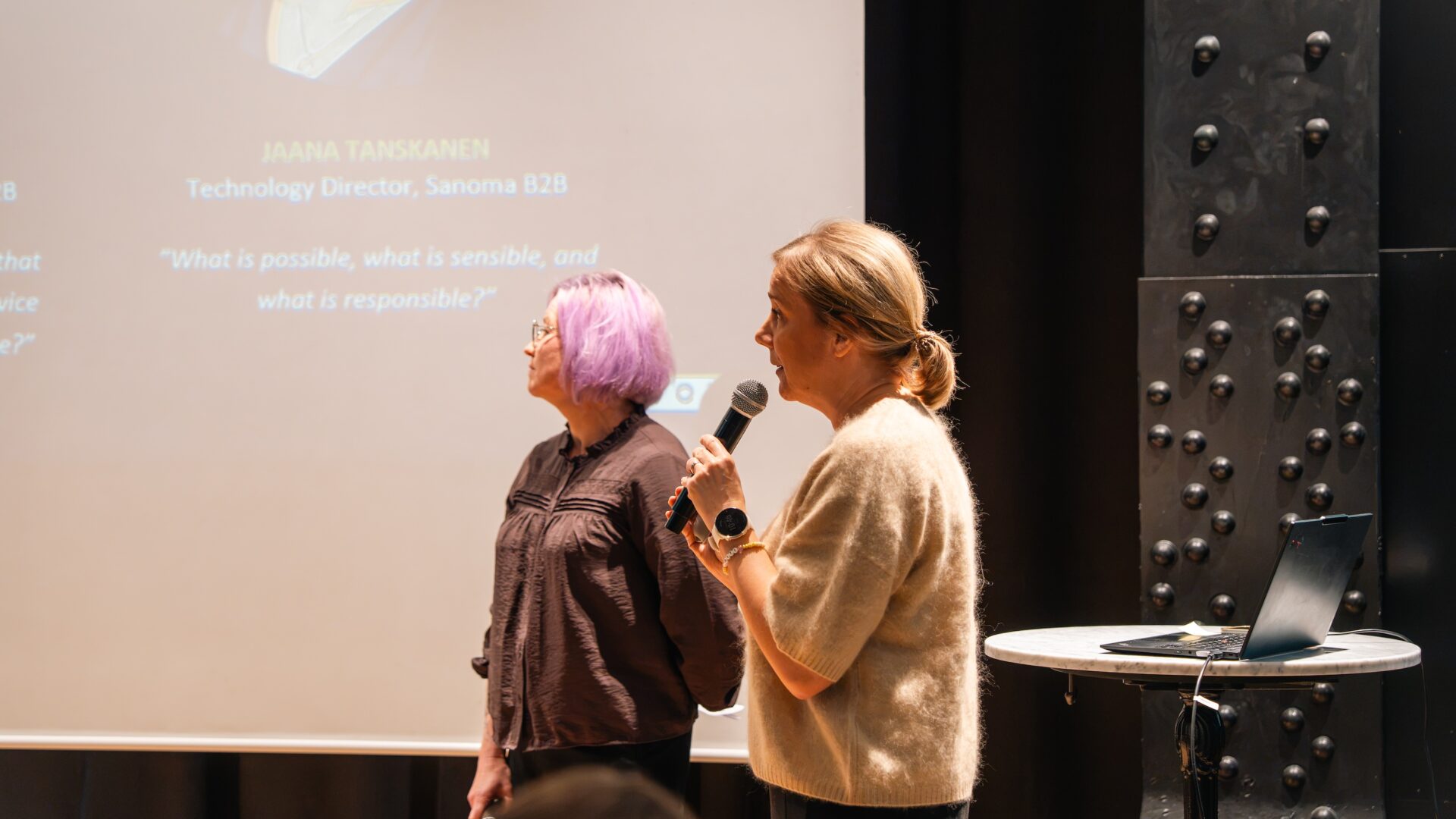
Sanoma has about 500 key accounts with named teams, and more than 10,000 SME customers served by about 50 sellers. Two years ago it chose the SME segment as the place to start, because the growth potential was largest there and hiring more sellers was not the answer. The work runs on two journeys:
- Sales-rep-led. Every seller gets AI “game buddies” for each step of the sales process, such as a scout at the start and a playmaker who helps build the proposal.
- Digital. AI-NOMA, a virtual salesperson, meets potential advertisers on Sanoma’s news sites and takes them from first contact to a proposal and the digital buying channel.
Both run on shared data and business logic, built so that AI agents can also buy from Sanoma. Their learnings were to start from the business objective, to tell sellers what is in it for them (more time with customers), and to involve middle managers, because that is where AI change succeeds or fails.
Panel: start with the problem you are solving
The closing panel brought together Jerker Olofsson (CCO, Candela), Danielle Grapne (Director of CRM and Sales Enablement, Schibsted Marketing Services), Paul Fournier (Senior Manager Sales and Business Development, Scania Industrial Batteries) and Teea Björklund (Sanoma).
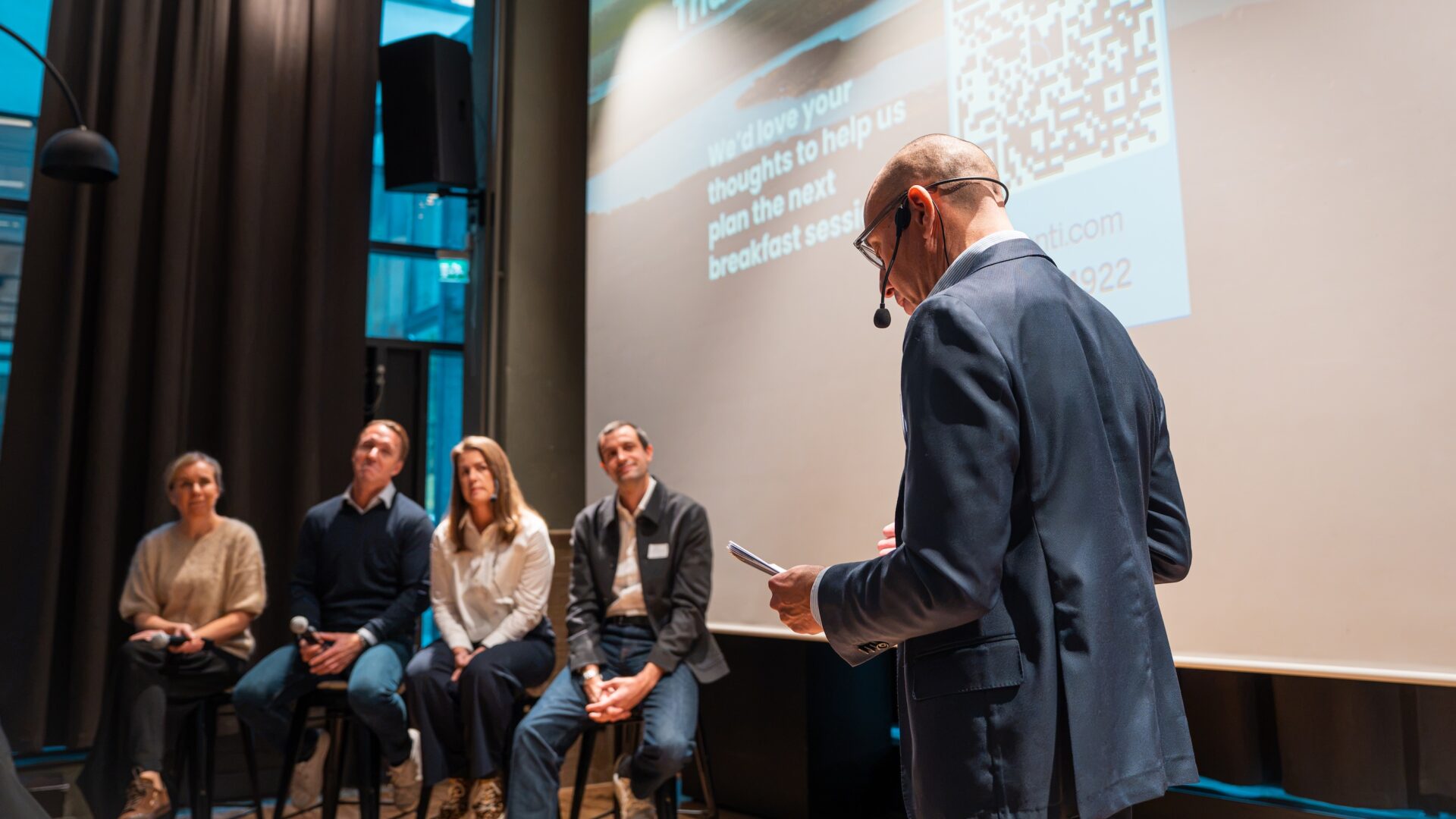
Three themes came through:
Where you start is a business decision. Two media companies made opposite choices. Sanoma started with the long tail, where it saw the most room to grow. Schibsted started with its largest accounts, because management wanted quick proof and sales is the core of the business. Danielle named what surprised them about the data: “we didn’t know quite how fragmented it actually was.”
Find the real problem first. Jerker’s problem at Candela, which sells electric hydrofoil ferries, was too many leads. Many people want a ferry, few can complete the purchase, and salespeople see opportunity everywhere. Candela used AI to find operators with both a business fit and a buying trigger, such as a new CEO or a renovation program. “Selling is essentially coaching the customer how to buy,” Jerker said.
Be honest about how long it takes. Paul described how Scania Industrial Batteries, formerly part of Northvolt, used account orchestration to reach the stakeholders who needed to hear about the change of ownership. After a year the brand is more visible to key stakeholders, and with sales cycles of one to four years, it is too early to claim a revenue breakthrough.
Asked for one thing to draw on the whiteboard, the panel answered: remove the silos and build cross-functional teams (Teea), make the management team aware of the capabilities needed to scale (Danielle), and understand how your customers buy (Jerker).
The universal first step: leadership readiness
Christoffer closed with five jobs to be done before data and AI pay off in sales:
- Choose your playbook: the long tail, key accounts, or both.
- Set a commercial target you can defend to your CFO.
- Lead with business, technology and sales excellence together, as Sanoma does.
- Redesign the operating model, the teams and the processes.
- Secure the data for your first use cases.
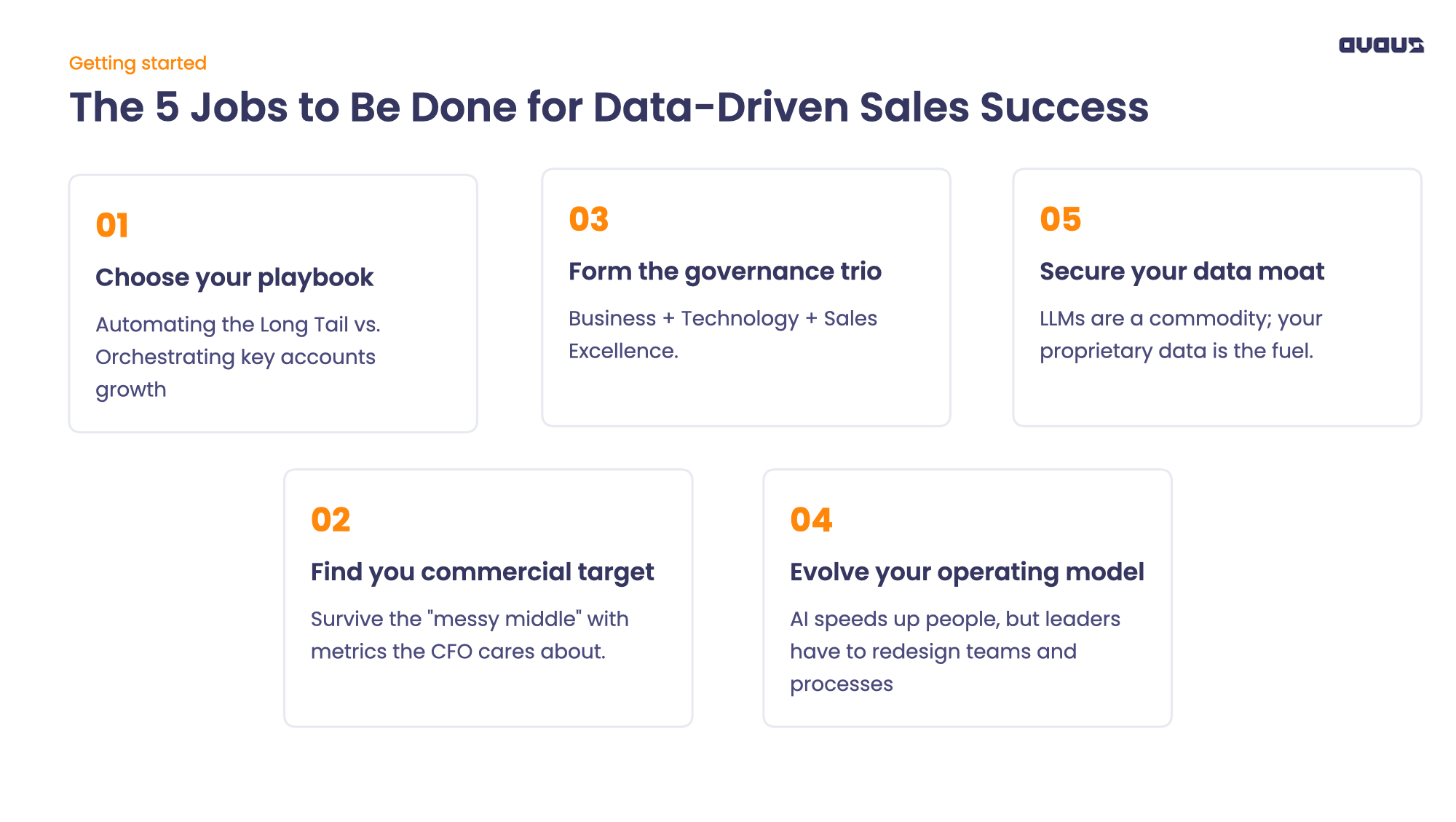
The five jobs to be done before data and AI pay off in sales. Slide: Christoffer Agneborg, Avaus.
The first step he promised at the start comes before all five: get the executive leadership team ready to own the work before the project starts, through a playbook simulation or an upskilling session. We make the same argument in why your AI strategy shouldn’t exist, and you can read how the same question played out at our Helsinki breakfast in May.
Ready to take your own first step?
Get in touch to learn more
Our next breakfast event takes place in Helsinki on November 12th at G Livelab. Space is limited, register here.