If your organisation has an AI strategy that sits separately from your growth strategy, you have already made the first mistake. Over two sessions in June, Avaus CEO Emma Storbacka and Joakim Rönnblom, Director of AvausOS, walked more than 150 registered participants through what a credible, P&L-connected AI approach actually looks like. Here are the key takeaways.
Watch the full webinar recording on demand here.
The problem with most AI strategies
Most organisations are somewhere between vague ambition and scattered pilots. They see the potential, but the link to measurable commercial outcomes is missing.
The numbers back this up. MIT research found that 95% of generative AI pilots at companies are failing to deliver. CIO reporting found only 25% of AI projects are meeting expectations. McKinsey’s global survey of nearly 2,000 organisations found no more than 10% have scaled AI agents in any individual business function.
What drives this gap is rarely a lack of tools or ideas. It is a lack of structure around where value actually sits, and what it takes to capture it.
The question most leadership teams are asking is: “What could we do with AI?”
The more useful question is: “What should we do with AI, and in what order?”
Three design principles for an AI plan that holds
1. Align with business strategy
If you design your AI initiative as a side project, it will stay a side project. AI belongs inside your commercial strategy, your sales excellence programme, your marketing plan. Already at the design stage, separating it out is a failure mode.
2. Consistency AND flexibility
You need an operating model that delivers steady, predictable improvement month over month, and a use case approach that lets you shift priorities as the environment changes. Without operating model focus, use cases stay scattered and never compound. Without a use case focus, the operating model becomes slideware and management jargon. Both have to be in place at once.
3. Create a strategy for your future org
AI agents will increasingly be part of executing your strategy, working alongside human teams. A well-designed slide deck communicates to humans. It does not give an AI agent enough to act on. Specificity, structure, and consistency matter more than they ever did.
From pilots to P&L: where most organisations are stuck
The pattern we see across Nordic and DACH enterprises is consistent. There are proof-of-concepts. There are tools in place. There are internal demos. What is missing is a structured path from those activities to commercial outcomes that show up on the P&L.
The methodology for getting there is not complicated, but it requires discipline:
- Set direction. Lock in the ambition and where you want to go, with alignment from the board down through sales, marketing, IT, finance, and HR.
- Identify your value drivers. Is growth most likely to come from acquiring new customers, selling more to existing ones, or launching new offerings? That is where AI should be focused first.
- Map use cases to value drivers. Each use case should connect to a value driver, a capability requirement, and a data dependency. From a long list of 50 to 200 potential use cases, narrow to a shortlist of 10 to 30 to implement in the next cycle.
- Build a roadmap. Consolidate use cases into a sequenced plan with multi-year milestones, a near-term roadmap, and an investment plan.
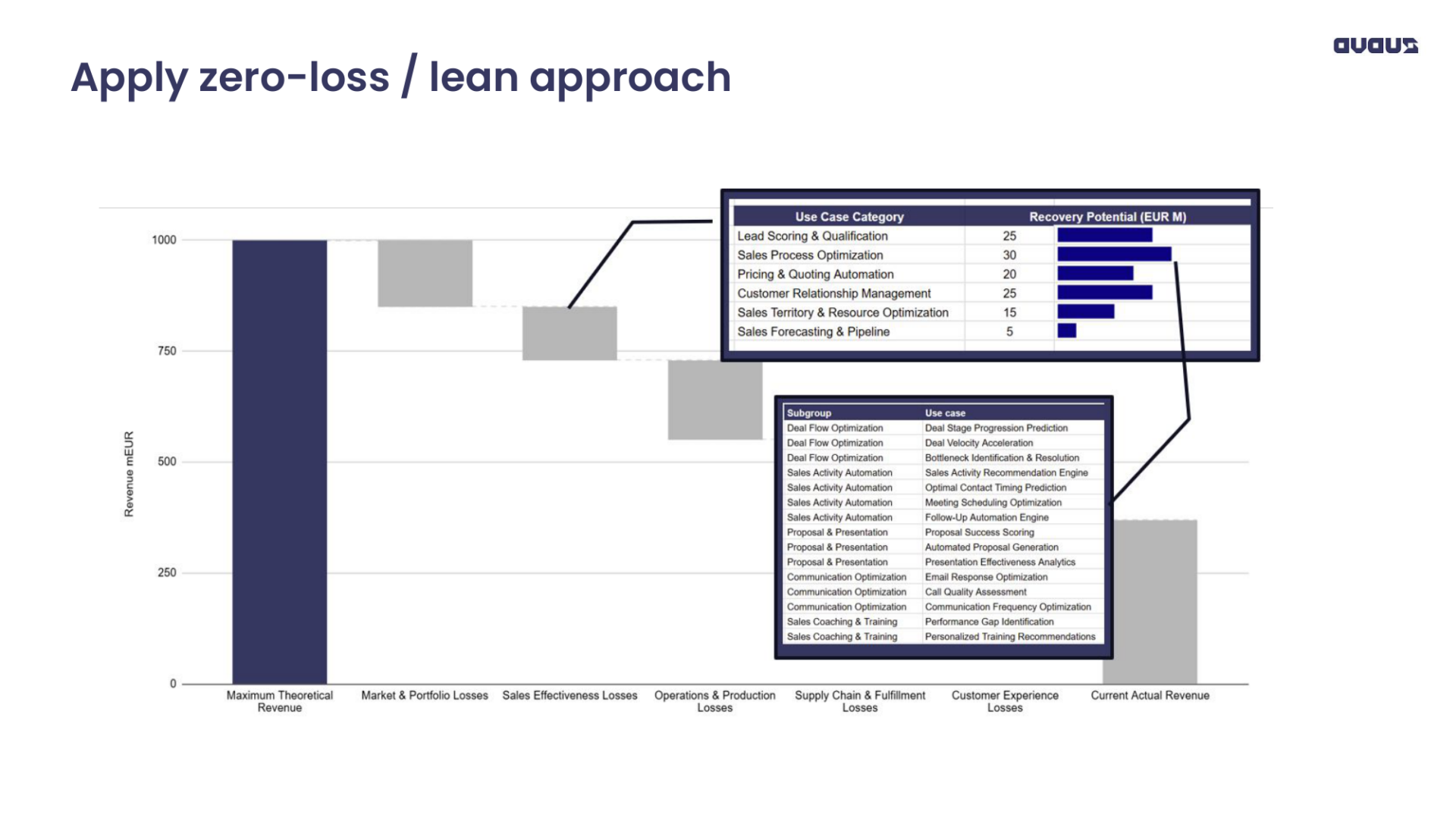
Applying a zero-loss, lean approach makes the value gap visible. By mapping current revenue against theoretical maximum and breaking the losses down by category, from lead scoring to sales process optimisation to pricing automation, the recovery potential becomes a number you can act on, not an abstraction.
For use case planning, we use the Data–Algo–Action framework, which covers five types of use cases:
- Automations handle rule-based processes without an LLM, like dynamic pricing or churn prevention
- Advisors coach and guide on demand, like sales coaching or internal Q&A
- Generators create deliverables on demand, like proposal generation or account plans
- Monitors watch, alert, and recommend, like market scouting or customer health monitoring
- Workflows execute multi-step processes that combine several of the above, like territory design or account research
If you are not sure where to start, the this Use Case Navigator is a good first step.
The operating model does more work than the technology
The gap between what organisations could be doing with AI and what they are actually doing is at its widest point in history. Technology develops exponentially. Organisations evolve incrementally. That gap is only going to grow.
The ambition is there. The infrastructure to support it is not. Deloitte found that half of organisations using generative AI now plan to deploy autonomous agents by 2027, doubling from 25% a year earlier. But HBR Analytic Services found only 8% of organisations have actually built the infrastructure needed to scale AI agents across the business. Stanford’s AI Index confirms the result: fewer than 10% of organisations have AI agents deployed across nearly every business function.
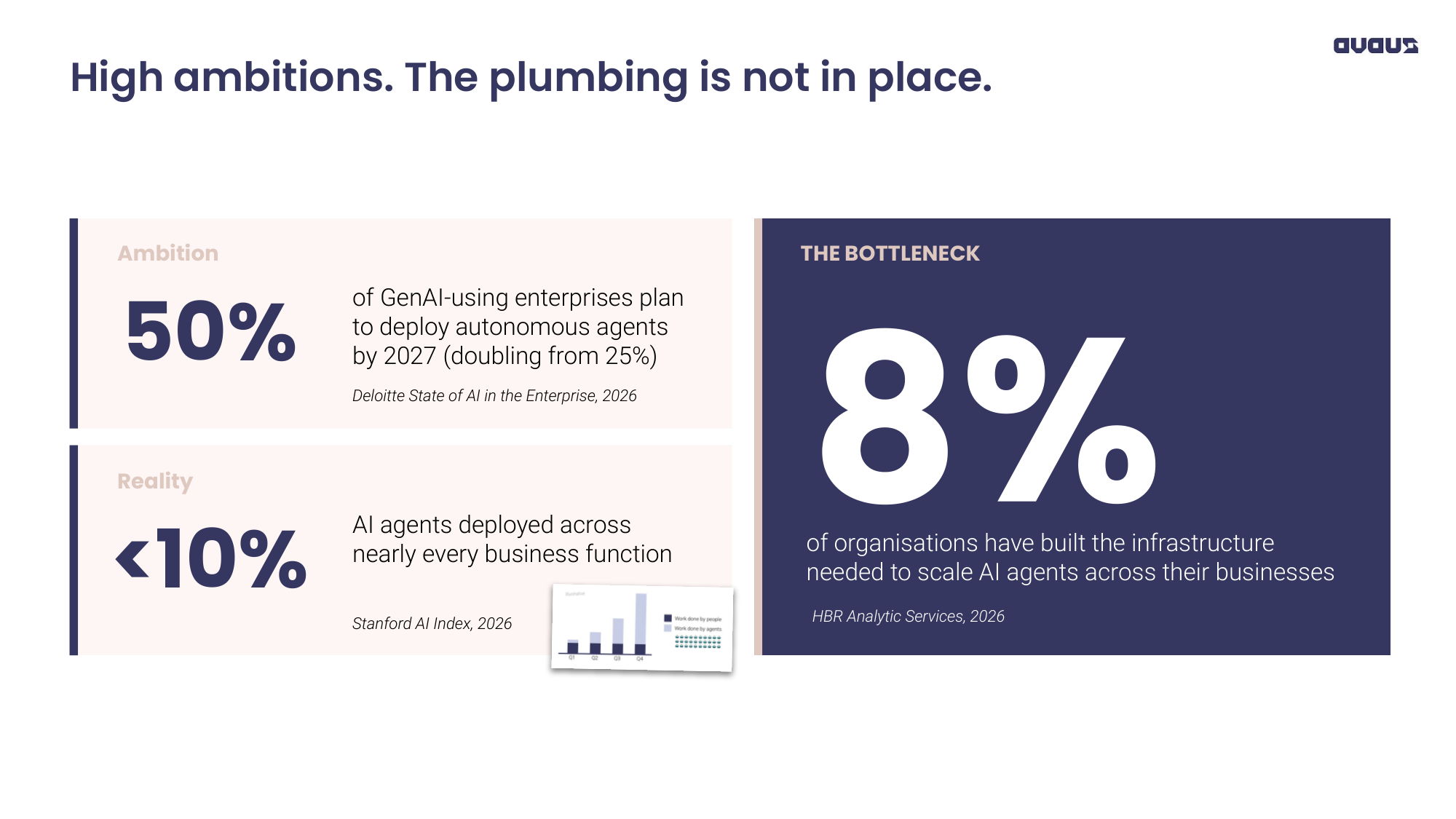
High ambition, low readiness. Half of generative AI users plan to deploy autonomous agents within two years. Less than one in ten organisations has the infrastructure in place to do it at scale.
What the best-performing organisations have in common is not better tools. It is a more rigorous operating model. Voi, the European micromobility company, put it well in a public account of their own AI journey: the tech mattered, but the operating model mattered more. You can find Voi’s AI-native playbook here.
We use a 40-dimension operating model framework to map where an organisation sits and where the friction is. It covers targets, strategies, structures, use case implementation, capabilities, governance, measurement, and change management. Running a health check against this canvas gives leadership teams a concrete view of what is sufficiently addressed, what requires attention, and what is a significant blocker.
Take our operating model assessment to see what this looks like for your organisation. It takes around 20 minutes and gives you a structured, shareable view of where to focus.
Change management is consistently underfunded
This is not a new observation, but it remains true. The people who need to change the most are at the top of the organisation, not the front line.
For frontline workers, the upskilling need is relatively small: existing roles get enhanced, not transformed, and the requirement is basic AI fluency combined with the socioemotional skills AI cannot replace. For specialists, the need is medium: they will increasingly teach and fine-tune agentic systems and manage exceptions. For managers, the need is significant. Managers have to build integrative, end-to-end thinking and the ability to oversee and optimise AI-powered workflows, a different job than the one most of them were trained for.
One pattern that drives failure is what we call the Bermuda quadrant: the zone where AI initiatives stall because they sit at the intersection of strategic and operational, and of business and IT, with no single owner navigating across all four. Without deliberate governance there, the work fragments and disappears into the gap.
We run half-day AI workshops for C-level executives in Helsinki and Stockholm each quarter, and immersion programmes for management teams working through this together. See upcoming sessions.
How Avaus is building this in our own business
Joakim walked through how AvausOS, our own AI-powered operating model, has developed over the past 18 months. The honest account: we started with technology, learned quickly that technology alone does not get you far, and shifted to building the context layer that makes AI useful at scale.
The core insight is this: enterprise value from agentic AI is a function of model capabilities multiplied by context quality. Anyone can access the same LLM capabilities. What creates a proprietary advantage is the context, the organisational knowledge that tells AI what to do, how to do it, and what good looks like in your specific situation.
For us internally, that has meant working across four fronts at once: helping people learn to use AI, building AI into daily work, making the technology easy to use, and giving AI the right data.
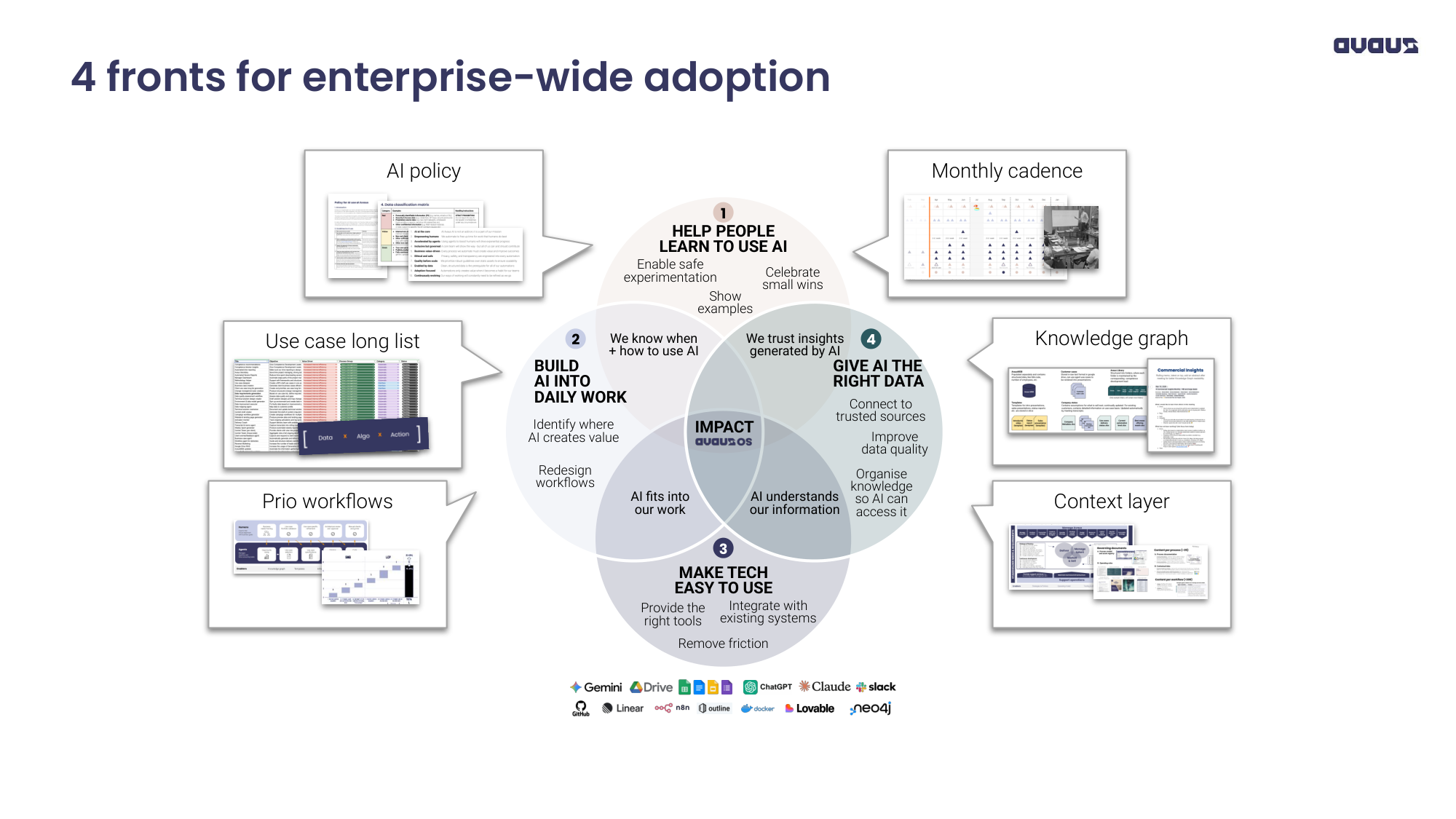
Enterprise-wide adoption needs all four fronts moving together. Skip any one of them, an AI policy without daily-work integration, or clean data without people knowing how to use the tools, and the other three stall too.
The context layer itself has three components:
- Policies and process documentation, what gets done, toward which goals, and how work flows through the organisation
- Tacit knowledge, the guidelines and best practices that live in people’s heads but are not documented explicitly enough for AI to use
- Quality criteria, the standard that separates good output from poor output, and junior work from senior work
Without the third component in particular, agentic AI produces work that is directionally correct but not production-ready.
For us, that has meant codifying 38 processes and around 250 sub-workflows, and building a shared taxonomy across four asset classes: methodology assets, use cases, capabilities, and tools. Roughly 300 methodology assets, 250 use cases, and 30 enabling tools sit in what is effectively the company’s asset registry, an ERP for how the business works.
We currently have roughly a third of client assignments linked to outcome-based billing. The target is above 50% by the end of 2026. When AI improves internal quality and efficiency, the right model is one where client success and Avaus success move together.
7 things to take away
- Stop treating AI as a separate workstream. Embed it in the growth strategy and give it a seat in commercial planning.
- Use value drivers, not use case lists, as your starting point for prioritisation.
- Map your use cases to the Data–Algo–Action typology: automations, advisors, generators, monitors, and workflows.
- Apply a zero-loss approach to quantify the gap between current and theoretical performance, by use case category.
- Assess your operating model honestly across all eight dimensions, from targets to change management.
- Invest in executive-level change management. Not awareness sessions: structured time, in-room, working through decisions that only leadership can make.
- Build your context layer before you scale agentic AI. Policies, tacit knowledge, and quality criteria are what make AI useful in your specific organisation.
If any of this raises questions about where your organisation stands, get in touch and we can work through it together.
Contact us
PS. Watch the full webinar recording and explore the Use Case Navigator, operating model assessment, and Data–Algo–Action framework.