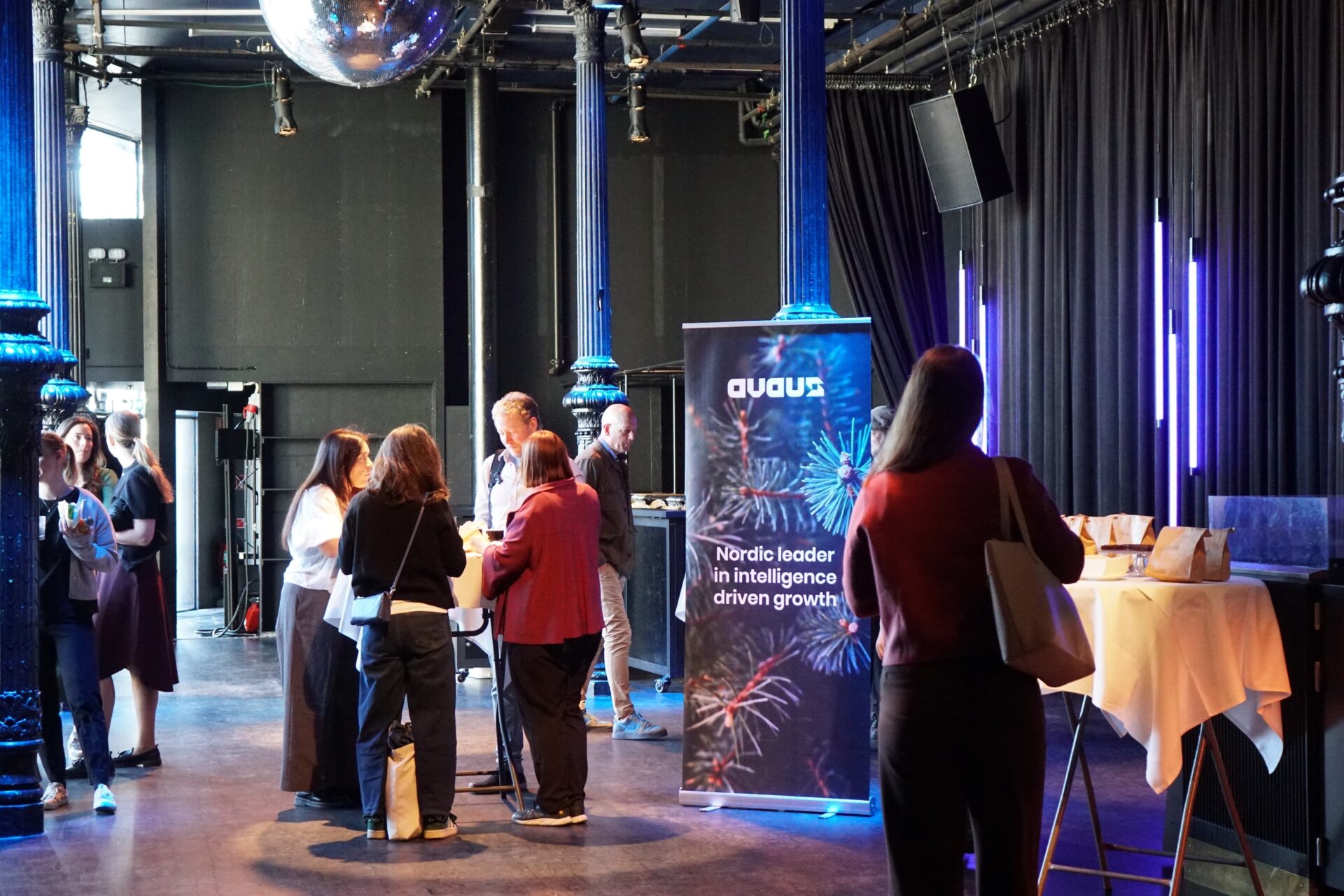
On 23rd April, 50+ professionals curious about data and AI gathered at Södra Teatern in Stockholm for a morning on how to use data, AI, and automation to drive growth and business results. On stage, commercial leaders from Dustin, Scania, SEB, Telenor, and Awolve discussed the topic and shared their insights and learnings. This blog covers what was brought up during the morning.
“The room is full of people. For now, at least.”
That was the opening line from our CEO Emma Storbacka, a half-joke, half-serious provocation. But the question running through the entire morning was not “will AI replace us?” but rather: what does it take to capture the value from agentic AI, and why are so few organisations managing it?
We heard four perspectives. Dustin, a large Nordic IT distributor, building a commercial AI engine from the ground up. Avaus sharing the hard lessons of building for an agentic future internally. A leadership thinker from Scania reframing what it means to lead when agents join the team. And a panel from SEB, Telenor, and Awolve getting honest about the debt, technical and emotional, that stands in the way.
The framing: what is agentic AI?
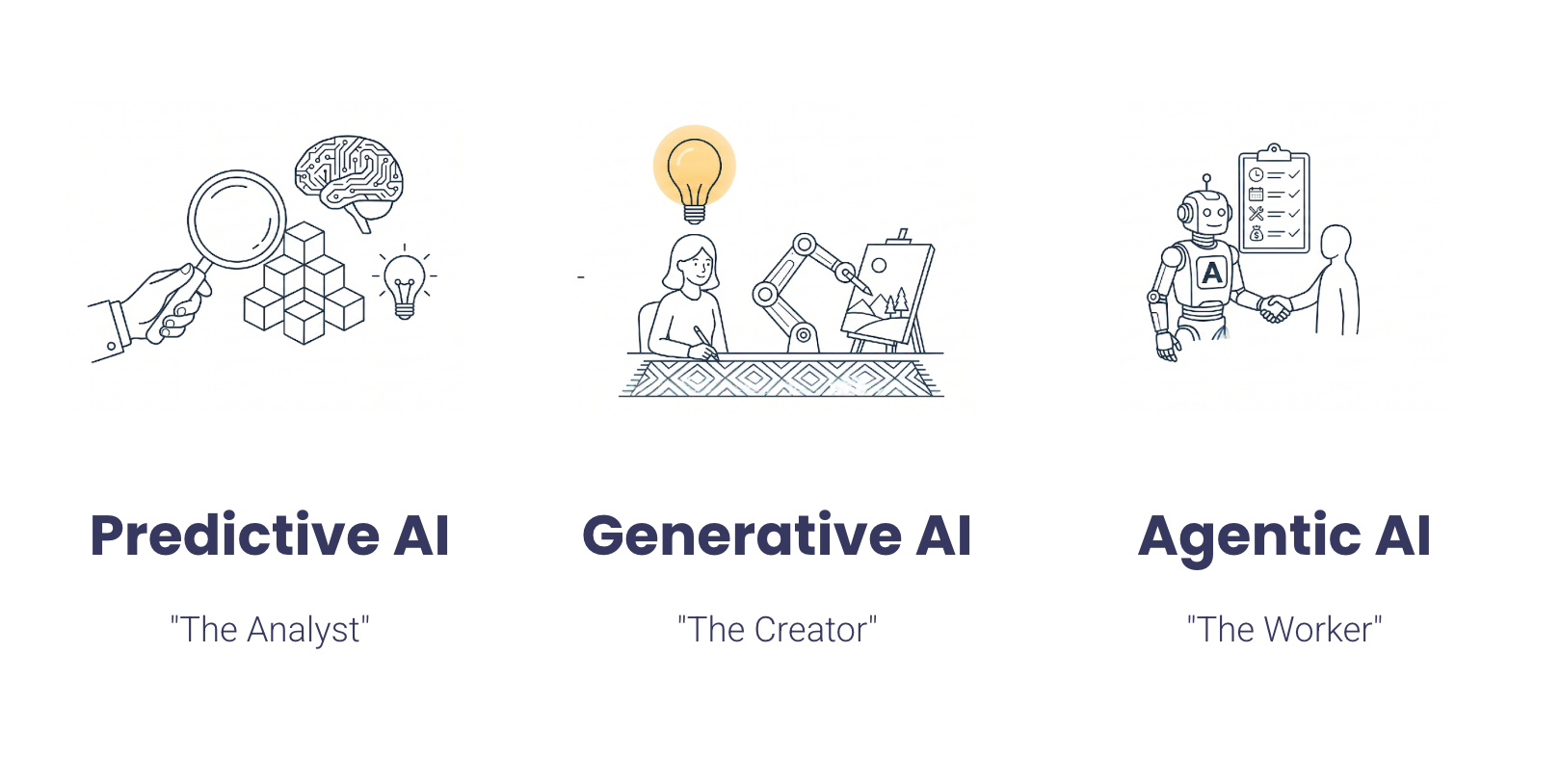
Emma opened by drawing a distinction that matters:
-
- Predictive AI is the Analyst: it surfaces patterns and scores.
- Generative AI is the Creator: it drafts, designs, imagines.
- Agentic AI is the Worker: it plans, acts, and loops back.
These live together, and any serious AI transformation in a commercial function will involve all three. What is different about the agentic layer is that it changes the nature of automation from task execution to goal pursuit. It is the shift from AI doing something for you to AI doing something on your behalf.
McKinsey estimates that 60% of the value AI will generate in marketing and sales will come from agentic deployments. Whether that number is exactly right or not, the direction is clear. The question isn’t whether to engage, it is whether your organisation has what it takes to scale.
Dustin: start with the strategy, then calculate the business case
Stephanie Forsblom, EVP Online Sales at Dustin, was direct: without a clear commercial business case and the right stakeholders behind it from day one, the programme will not move.
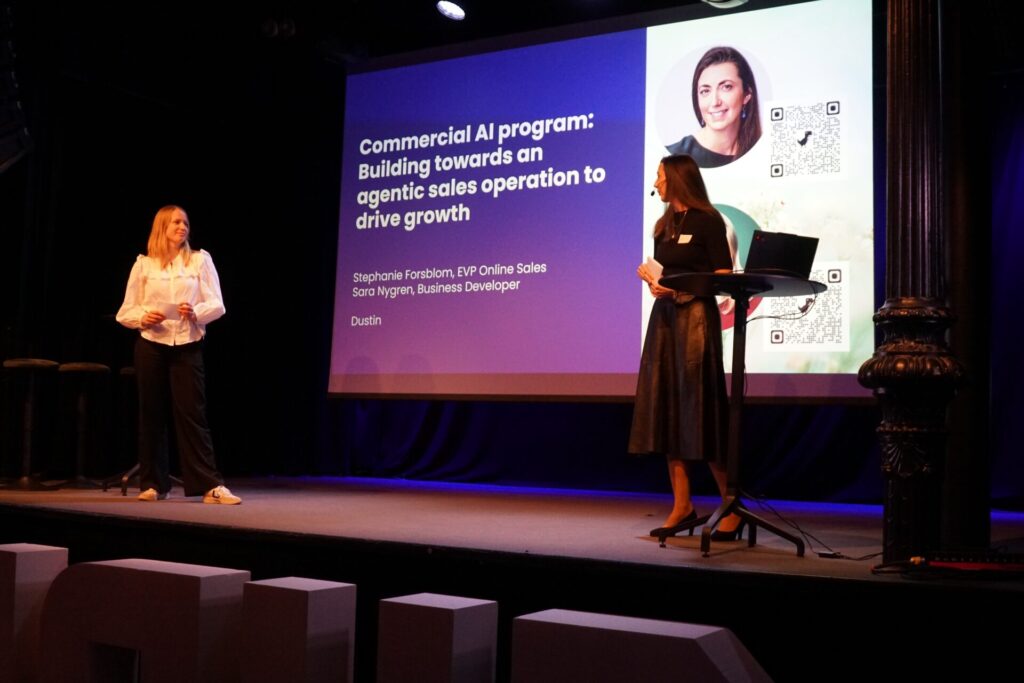
Dustin operates across the Nordics and Benelux with roughly 23 billion SEK in annual sales and around 2 million orders a year. They had been doing analytical AI and machine learning for years. The commercial AI programme, CAP, is not a new idea for the company. What is new is the ambition and the structure around it, and it is a programme that Avaus is part of building.
-
-
- Year one is about the foundation: 70-80 use cases launched, the operating model built, the measurement framework in place.
- Year two targets 200-300 automations and starts introducing agents into the mix.
- Year three reaches for 500-1,000 automations and, with that, genuinely autonomous commercial operations.
-
One example from the programme: an offering expansion model that analyses a customer’s historical purchases to predict what they are most likely to buy next. In its first launch (one market, one product offering, three channels) it produced three automations. Scaling it to three markets, three offerings, and five channels turns that into 45. That is the compounding logic. It is not about launching use cases. It is about launching use cases in a system designed to scale them.
Sara Nygren, Business Developer for the programme, also mentioned how much the operating model needs to iterate. Six months in, the team had already reworked their processes, measurement approach, and steering model. Which is exactly how it needs to be.
Joakim Rönnblom (Avaus): the infrastructure gap is real, and it starts with process
Our Director of AvausOS, Joakim Rönnblom, took the stage next to show how we at Avaus are tackling this at the moment.
The market data is striking. According to Deloitte, 50% of enterprises using generative AI plan to deploy autonomous agents by 2027, doubling from 25% today.
Yet fewer than 10% have actually deployed agents across any meaningful number of business functions. And only 8% of organisations have built the infrastructure needed to scale agents, according to HBR Analytic Services.
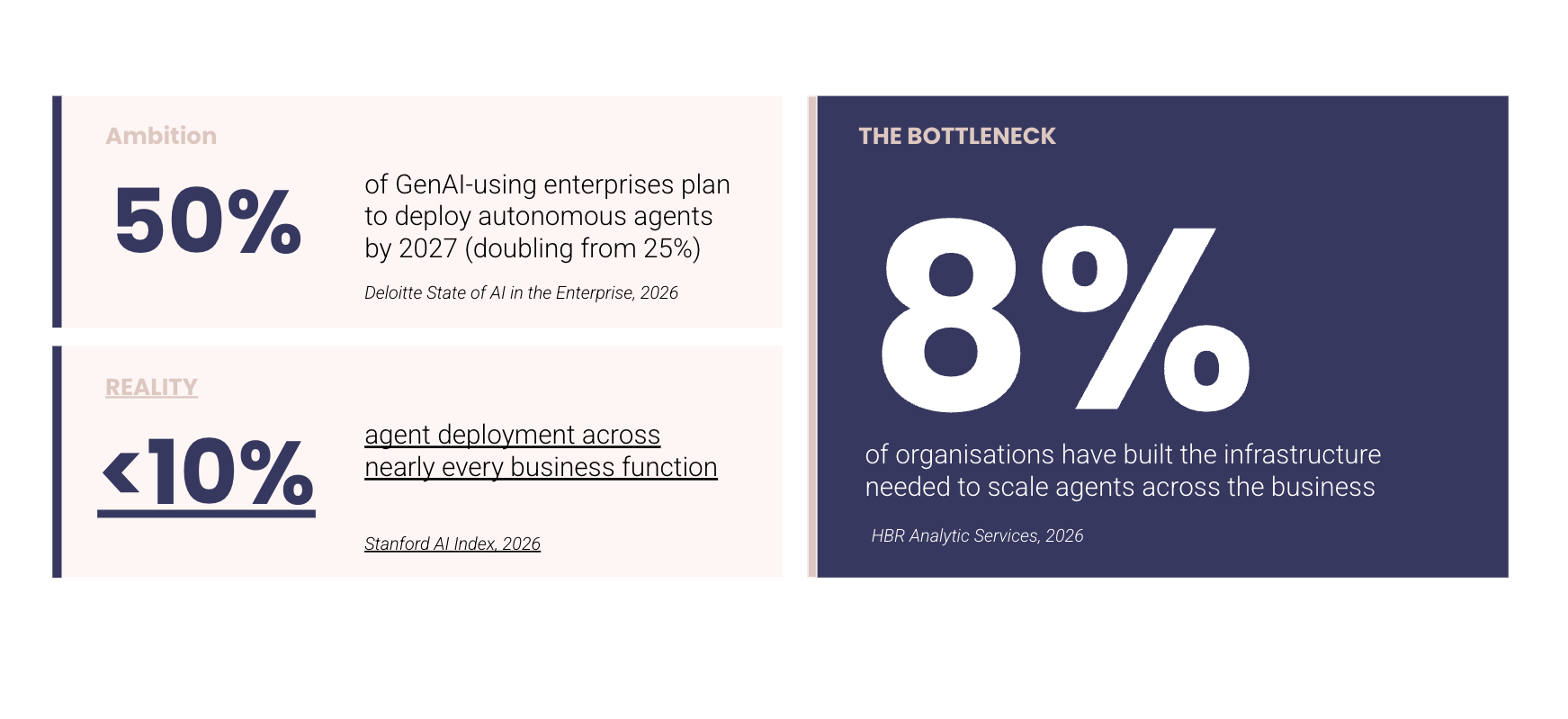
The gap between ambition and reality is not mainly a technology gap. It is an infrastructure gap, which in this context means process.
When Avaus started building for an agentic future, we went in at the top of the stack: deep prospect research, intro meeting slide generation, account drive administration. Smart use cases. But the lesson we learned quickly is that you cannot scale agents without a solid process foundation underneath them.
Joakim laid out the model as a pyramid:
-
-
- At the base: process foundation — defined processes, clear ownership, policies.
- Above that: a data layer (clean and connected).
- Then integration (automated data flows across systems).
- Then automation (triggers and rules).
- And at the top: the AI layer with agents and agent-powered workflows.
-
Most organisations try to start at the top and work down. The ones that scale build the base first.
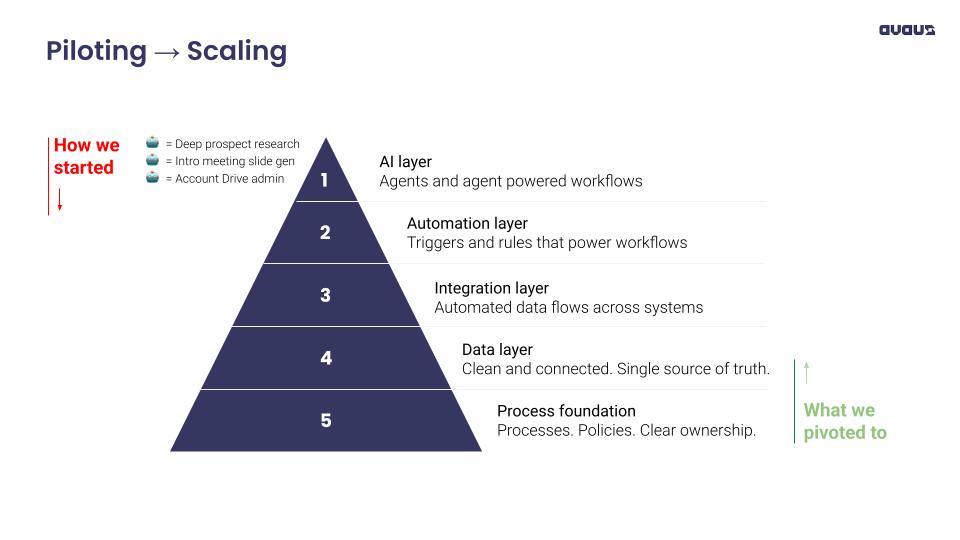
In Avaus terms, that base is AvausOS. It contains around 35 processes, roughly 200 workflows, approximately 90 use cases, and 220 methodology assets. It is not glamorous. It is the operating system, processes as the world model, taxonomy as shared language, asset registry as the ERP (Enterprise Resource Planning).
The insight that cuts through everything: enterprise value from agentic AI equals model capabilities multiplied by context quality.
The models are largely commoditised, what differentiates your output is how well the AI understands your world. That is a knowledge problem. And it requires three things:
-
-
- clear process descriptions (what gets done, toward which goals, with which tools),
- contextual knowledge (the guidelines and best practices that people carry in their heads but have never written down), and
- quality criteria (what does “good” actually look like).
-
If you cannot articulate how work should get done, you cannot build an agent to do it.
There is also a governance dimension that sits above operations entirely. A Dagens Industri opinion piece recently published argues that as middle managers are displaced, “shadow agents” are filling the vacuum. Shadow agents that most organisations have no system-wide view of what they are doing or who is accountable for them.
The questions belong on every management team agenda:
-
-
- Which agents are active, and what data are they acting on?
- Which decisions can AI make independently, and which require human oversight?
- When something goes wrong (and it will) can you reconstruct what happened and who is responsible?
-
Most organisations running AI programmes at any scale are already in this territory, whether they have answers or not.
Patrik Hedljung (Scania): three jobs leaders will need to do, that aren’t in any job description
Patrik Hedljung, Manager of AI Adoption at Scania, started with the question he believes matters most.
Not “will agents replace our people?” The real question: what remains of leadership when part of the work is done by something that is neither human nor tool?
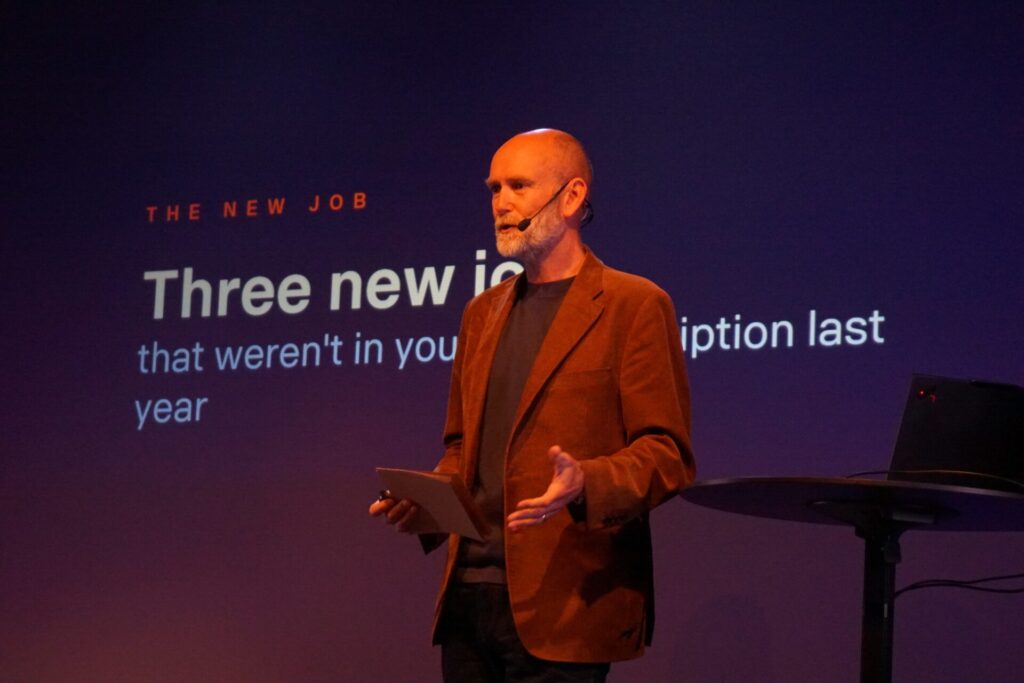
He introduced three new leadership areas:
-
-
- Conduction. The conductor metaphor for leadership is not new, but it gets more complicated with agents in the mix. Leaders have always had to manage diverse teams. What changes is that agents require a completely different leadership style to humans. Humans want autonomy. Agents want context, clear instructions, and defined processes. As a leader managing mixed teams, you now need to switch styles in real time. And you need to think about how humans and agents communicate with each other, including all the subtle, informal cues that currently happen through hallway conversations that agents will not replicate in the same way.
- Configuration. Patrik shared an example from Scania New Zealand. A credit analyst not on anyone’s radar had built an agent that cuts hours from his daily work. He reached out to Patrik not through any formal channel, but because he found his name on the internet. The point: the people best positioned to create value in an agentic organisation are often not the ones you expect. Competence is no longer a property of a person alone. It is a function of configuration: finding the right person, putting them in the right context, giving them the right tools.
- Curation. In an agent-infested organisation, there will be no shortage of outputs (proposals, leads, ideas, content). The production that used to be a bottleneck is now abundant. The new bottleneck is selection. Who picks? Who decides which of the 2,000 good ideas actually gets actioned? That requires taste and judgment, which are capabilities that almost never appear in development plans or competency frameworks, but that will define how much value organisations extract from their agentic investments.
-
The thread connecting all three is courage. Not a technical capability. A character requirement. Because in each of these three roles, you are asked to make a decision without having the data to fully justify it. To redesign a workflow before you are sure it won’t work. To find your credit analyst before he appears in a pipeline. To reject an AI output that looks fine but isn’t good enough.
Patrik also introduced the concept of emotional debt, a counterpart to technical debt that organisations rarely account for. Technical debt is visible and has a budget line. Emotional debt sits in identity, trust, and belonging. It builds up when credit analysts build agents that compress hours from their colleagues’ jobs and nobody acknowledges it. It builds up when AI is rolled out with cost-cutting as the primary message. It does not show up in the books, but it slows adoption and kills ROI.
Panel: what actually unblocks AI transformation at scale
The closing panel brought together Mikaela Brinte (Head of Marketing & Digital Transformation, SEB), Asad Khan (Head of AI & Data Analytics, Telenor Sweden), and Mattias Aspelund (Co-founder and CAIO, Awolve). The discussion was honest in a way that conference panels rarely are.
The emotional debt thread from Patrik’s talk was the natural bridge into the panel discussion. Constant change erodes identity, and that is not a soft problem. When people’s sense of professional value is tied to a skill that an agent now does faster, the rational response is resistance, not adoption.
The panel’s view was that most organisations are not naming this clearly enough. They are measuring adoption rates and use case deployment, while the actual blocker is in how people feel about what AI means for them personally. Acknowledging that openly, rather than papering over it with upskilling programmes, is what creates the psychological safety needed to actually move.
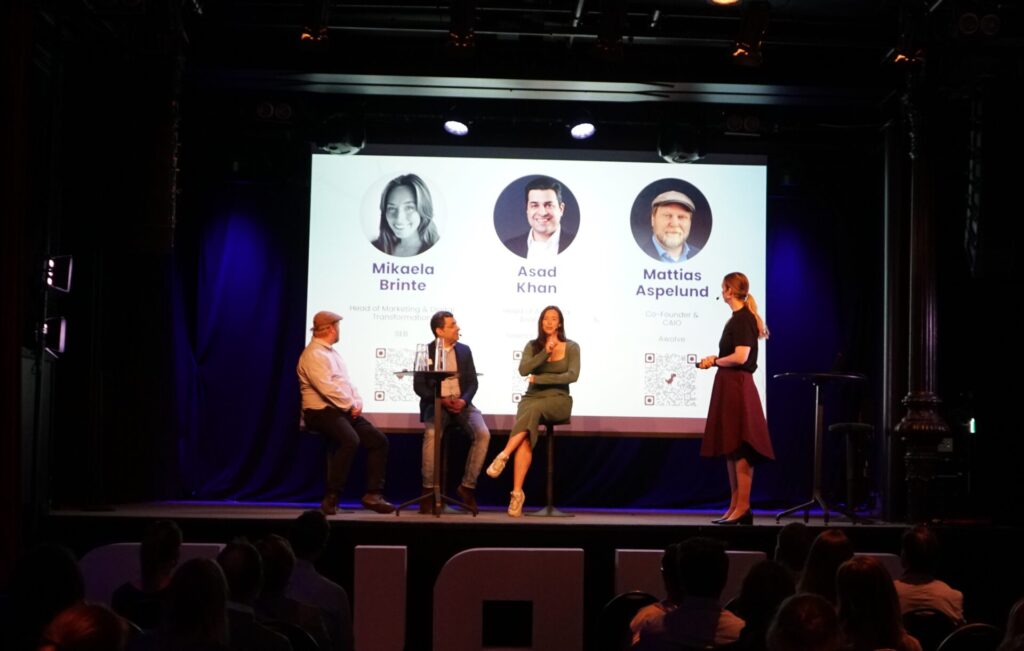
Three other themes cut through:
Upskilling is necessary but nowhere near sufficient.
Most organisations are providing access and learning-by-doing. That helps, but the ceiling is low. Asad framed it as the 80/20 problem: AI can now handle roughly 80% of many knowledge tasks. The last 20% (judgment, context, explanation, ethics, the human element) is where human value lives. Preparing people for that last 20% requires practice and real application, not a two-hour LinkedIn course.
Mattias added a harder observation: most upskilling right now is teaching people to use AI as a tool, when what we actually need is to teach people to work with it as a system, or as a colleague.
Cross-functional urgency is the mechanism.
At SEB, Mikaela’s team now runs innovation sprints where everyone, business and technology, works on real use cases together at the same time. When you put those people in the same room, the magic happens quickly. The risk she identified is the “dutt” problem (a Swedish term for scattered, uncoordinated activity): everyone is doing something with AI, but none of it compounds. Structure and shared prioritisation are what turn individual experiments into organisational momentum.
Leadership has to show courage and admit past failures.
Asad was clear that in Telenor, as in most large organisations, there is scar tissue from previous transformation attempts. That history creates reluctance. The antidote is not more frameworks, it is leaders explicitly acknowledging what didn’t work before, making it safe to take risks now, and pointing the direction clearly.
Mikaela added that she frequently encounters leaders chasing AI as a box-ticking exercise rather than asking what genuinely improves outcomes for customers or employees. Courage means starting from the customer problem, not the technology.
Mattias closed with a practical observation on vendors: any technology partner who won’t open their APIs for a cross-functional task force is not a genuine partner. In one financial services engagement, enormous value was being blocked because both an internal team and a vendor kept preventing the project from moving. If your vendors are slowing your AI transformation, that is a commercial negotiation, not a technical constraint.
Three questions worth asking in your organisation this week
Joakim framed the entry point for most organisations as three questions. They are simpler and more useful than most AI readiness frameworks we see:
-
-
- How could agentic AI create value in your business? Not where could we use AI, but where does the commercial logic for agent deployment actually hold?
- Do you have a plan for going from pilots to compounding results?Pilots are easy. Compounding is hard. The difference is a use case factory with an operating model behind it.
- Can your organisation articulate how work should get done? Not at a high level. At the level of detail an agent needs to act usefully.
-
If the answer to the third question is no, that is where to start. Not with the AI stack. With the process foundation.
Ready to move from theory to execution? If these questions are currently on your radar, we would be glad to continue the conversation. Our simulation-based workshop offers a hands-on way to pilot these concepts. We’ll help you identify your primary value drivers and gain a transparent view of where your model stands today.
Get in touch to learn more
Our next breakfast event takes place in Helsinki on 13th May at G Livelab. Space is limited – register here.