For years, MarTech in practice has been about specialists working in systems to increase automation and personalization, scheduling campaigns, segmenting audiences, and personalizing customer experiences at scale. But a new era is emerging, where AI not only complements the work but also executes tasks independently within human-defined objectives and guardrails.
The era we refer to is the age of Agentic AI, a shift that challenges the traditional model and redefines how marketing, sales, and customer engagement operate.
From rules to reasoning
Much of what’s called “AI” in today’s MarTech remains rule-based orchestration (journey steps, frequency caps, suppression lists). Machine learning powers predictions and recommendations, and LLMs add generation and reasoning. Agentic AI combines these to automate goal-directed decisions: selecting and executing actions across systems using data from multiple sources, under human-defined objectives and constraints.
Think of it as going from automation to autonomy.
In our guide, MarTech & Customer Data in the Age of AI, we predict that these AI “agents” will have two main purposes.
- Rule-based systems coordinating workflows between large language models (LLMs) and business tools using predefined paths. (Like n8n)
- Fully autonomous decision-makers capable of integrating data, learning from outcomes, and optimizing performance continuously.
This evolution means MarTech platforms will not only execute campaigns based on set of rules or triggers, but also decide what to execute next.
What makes Agentic AI different?
Agentic AI in essence represents a shift in how technology contributes to business outcomes.
- Autonomous decision-making: AI agents can analyze performance data, detect new opportunities, and adjust strategies in real time.
- Cross-system orchestration: Instead of being confined to one platform, agents can operate across multiple applications such as a CRM, CDP, Marketing Automation, BI and “communicate” to each other.
- Continuous optimization: Feedback loops with input from humans will allow agents to learn and adapt over time, improving precision and efficiency without manual retraining.
In short, where traditional MarTech automates tasks, Agentic AI automates tasks and decision-making under human-defined objectives and supervision.
Agent-to-human vs. agent-to-customer: the pragmatic path
Agentic AI is already proving itself in reactive service contexts, but marketing and sales raise the bar: proactive commercial activities demand brand-safe messaging, precise timing, and offer decisions across channels. For most organizations, that means higher brand risk, more complex decisioning, and tighter security/compliance if an agent talks directly to customers.
So start where impact is fastest and risk is lowest: agent-to-human. Let agents unify data, run models, and orchestrate workflows; let people review, approve, and execute. As data quality, governance, and monitoring mature, you can pilot narrow, well-scoped agent-to-customer cases.
The path to value runs through agent-to-human first. Teams that start here build their foundational capabilities as data infrastructure, cross-system orchestration, feedback loops, and team competencies that’s required for future expansion. They also generate measurable ROI faster, building confidence and securing continued investment.
Bottom line: Agentic AI’s most immediate impact in MarTech is making internal teams dramatically more effective, not replacing human-to-customer relationships
The end of the static stack
For decades and as long as we’ve worked with these questions, MarTech has followed a predictable pattern: buy a SaaS platform, configure workflows, and rely on regular updates from the vendor. But as Agentic AI matures, this model may no longer fit as the need for innovation to gain a competitive advantage will increase. Instead of subscribing to a fixed toolset, organizations will increasingly build living ecosystems where agents interact, coordinate, and evolve as part of the business.
This shift echoes a broader trend in composability and data-centric architectures: modular, API-driven systems that can evolve as fast as the market itself.
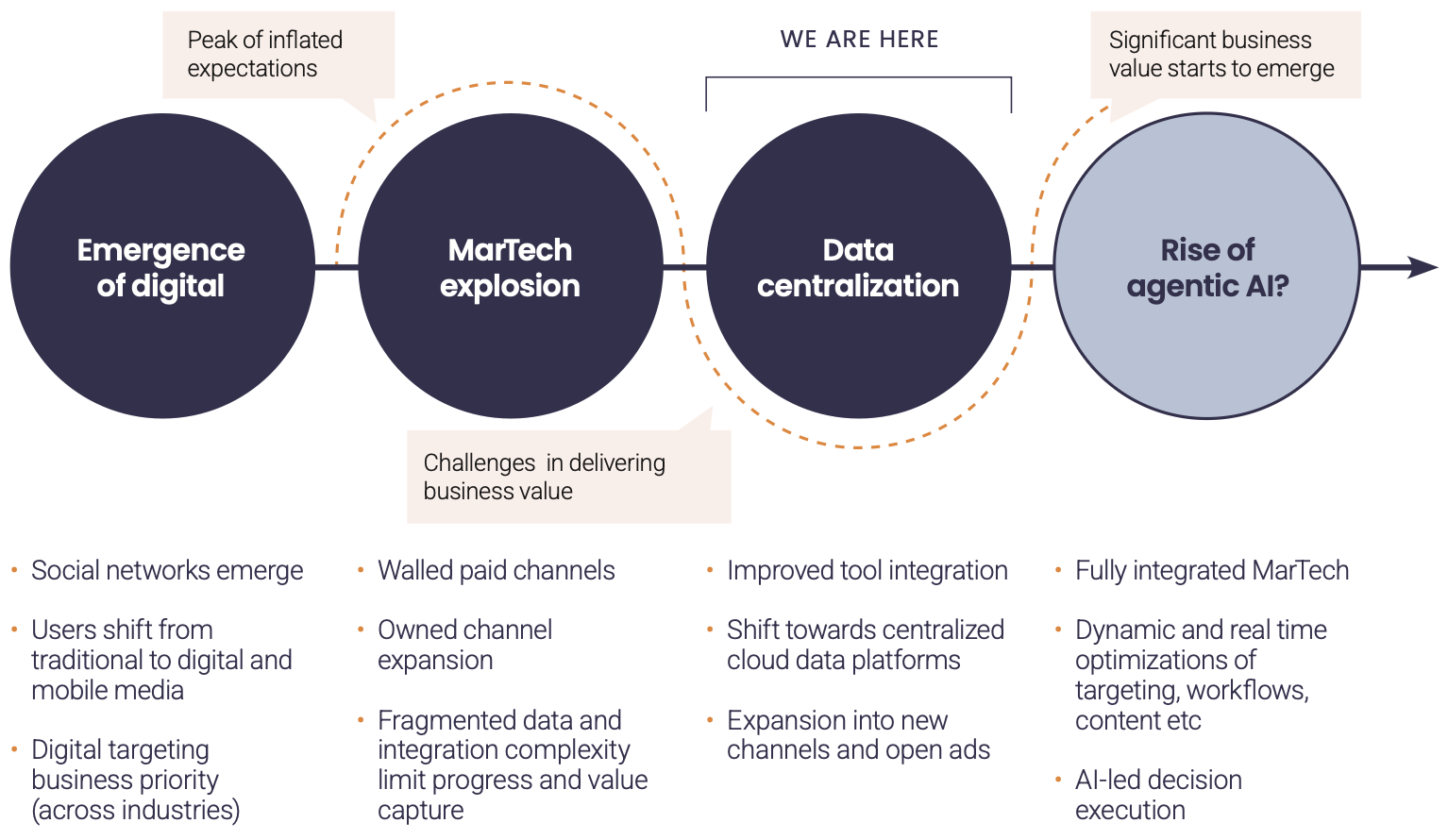
(A new phase: Powered by customer data and AI)
The building blocks of Agentic AI
Becoming “agent-ready” requires more than plugging in an LLM. It’s about creating an ecosystem that allows autonomous systems to operate safely and effectively:
- Unified data foundation: Agents rely on real-time, structured, and accessible data. Not fragmented silos.
- Composable architecture: Microservices, APIs, and cloud-native tools provide the flexibility for agents to integrate where needed.
- Governance and trust: Ethical frameworks, auditability, and explainability are crucial. Agents must be transparent and accountable.
- Cross-functional collaboration: AI adoption is not an IT project. It’s an organizational change that spans marketing, analytics, and leadership.
Organizations that already operate with composable MarTech stacks and clear data governance are naturally positioned to explore agentic extensions. Read more about composability in MarTech.
Conclusion: From automation to autonomy
The evolution from automated workflows to autonomous systems marks the next step of MarTech innovation.
As businesses strive to deliver more personalized, responsive, and relevant experiences for the customers, the ability to let AI act, not just analyze, will become a defining advantage. The shift towards Agentic AI won’t happen overnight, but it’s accelerating faster than most expect. Recent surveys indicate that 81% of tech executives plan to integrate AI agents across their tech stacks within the next three years, and over 40% of enterprises are already building agent prototypes.
Agentic AI won’t replace your MarTech stack but it will most likely redefine how you use it. But this new level of autonomy doesn’t change one timeless truth: poor data, poor output. No matter how advanced your AI agents or workflows are, they’re only as good as the data they consume. High-quality, unified, and ethically managed data remains the single biggest success factor because without it, autonomy simply amplifies the chaos.
Want to read more about Agentic AI and how it connects to modern MarTech approaches? Download our guide below.
Download guide