Most organisations today have plenty of customer data. They also have dashboards, reports, and in many cases, a handful of machine learning models that calculate probabilities or scores. But what often remains unclear is the part that actually matters: How does it turn into measurable business results?
This blog post is about turning customer data into real commercial impact. To do that, the model should not predict customer behaviour, it should suggest an action.
Predictions are not actions
A common pattern looks like this. A team builds an engagement model. It outputs something like:
Email: 18 percent likelihood to engage
SMS: 25 percent likelihood to engage
LinkedIn DM: 40 percent likelihood to engage
Interesting numbers, but nothing in that output tells anyone what to do next. The business is left to interpret the result. This is where most analytics efforts stall. The work is technically correct, yet practically unused.
Marketing and sales teams in particular face this constantly. They run high-frequency operations with clear KPIs and established channels for execution. They do not need more probabilities. They need decisions.
The Model is not the product
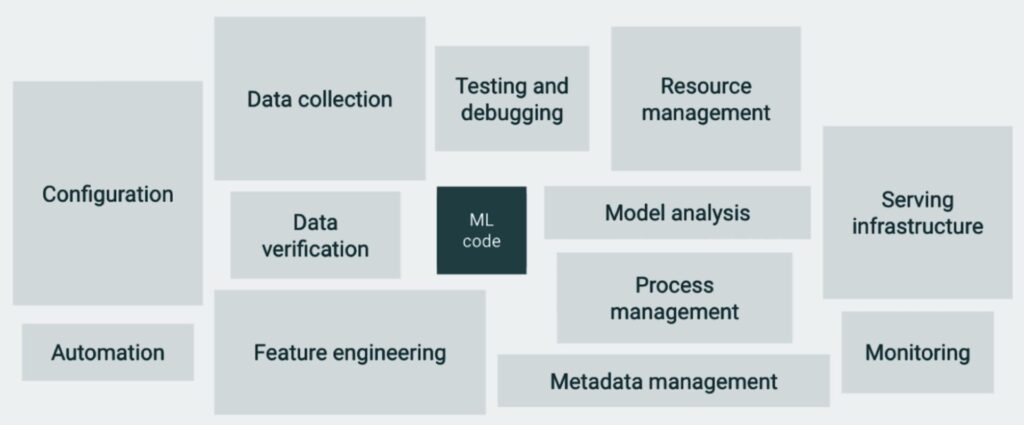
(A visualization of MLOps, showing that the model itself is a small part of the process)
As seen in the image, in a complete MLOps process the code creating the model is only one small part of the whole. This is a good reminder of how little value a model creates on its own. The model is not the product, actionable output is.
If the output is not directly actionable, all the surrounding machinery is wasted effort. The organisation risks falling back to manual processes and static rules, and the model will quietly disappear into the background.
What “actionable” actually means
Actionable does not mean insightful or interesting. It means something very specific.
- Clear target group
- Clear channel
- Clear timing
- Clear threshold
- Clear expected effect
Something like:
Send Offer A via SMS on Thursday at 09:00 to the 4,000 customers whose predicted uplift exceeds 20 percent.
This is a decision. It can go straight into your marketing automation tool, CRM workflow, or sales process. It requires no interpretation. It is measurable. And it closes the loop between modelling and execution.
Designing for actions instead of scores
If you want models to influence decisions, you have to reverse the usual modelling flow. Instead of starting with the data or the algorithm, start with the decision.
1. Define the business decision
What are we trying to do? Increase conversions? Reduce churn? Prioritise leads? Something concrete, with a KPI attached to it.
2. Package the output for execution
This step is to decide what sort of output the model will deliver. Importantly, this is done before any model development takes place. The goal of this step is to align on the structure of the output of the model, and this is done by creating a fake output. The output should have the exact same structure as the eventual real output, but the predictions will be random numbers. This fake output can then be used to align with the product owner for the receiving system: If we send information that looks like this, will it be actionable for you?
3. Build the model around that decision
Now that the exact output is defined, a model can be created that outputs in that exact manner. The model will now be perfectly aligned with the use case and the KPI:s.
4. Automate execution
The structure of the output has already been set in step 2, and the model itself is trained in step 3. Now, it is an MLOps question of making sure the model results are delivered in that fashion on a regular, scheduled basis.
5. Measure actual business impact
Accuracy is not the goal. Incrementality is. You measure lift, revenue, retention, cost savings. You use control groups. And you retrain based on what the business tells you worked, not only on what the validation metrics say.
A simple comparison
A model that predicts email engagement probabilities leaves the team wondering how to act on it. A model that outputs an SMS target list for Thursday morning worth an estimated 40,000 euros in incremental revenue does not.
Same data. Same data scientists. Same algorithms. But a completely different outcome.
Why marketing and sales benefit first
These functions have three things going for them.
- Clear KPIs
- Existing execution channels
- Constant decision cycles
When you introduce actionable modelling in these environments, the impact shows up almost immediately. The loop from data to decision to result is short, measurable, and repeatable. This is why most organisations see their first meaningful ML-driven ROI in marketing or sales, not in long-horizon or low-frequency domains.
A Checklist before you build anything
If any of these questions are unclear, the model will likely produce insight, not impact.
- Is the business objective clearly defined?
- Does the model output map to a specific action?
- Can that action be executed automatically?
- Can the result be measured incrementally?
- Do we know how the output will be governed and monitored?
- Will results feed back into the model?
Good models are not enough
Building a good model is no longer the hard part. The hard part is turning that model into something the business can act on.
We have seen teams transform their performance simply by shifting from predictive modelling to actionable modelling. For example, by moving from models that predict products that a customer wants to buy to models that predict where an offer will increase sales. It changes how decisions are made, how results are tracked, and how fast organisations can learn.
So if you are sitting on good data and good models but still struggling to show clear business value, it may be time to step back and ask a different question:
Are your models producing predictions, or are they producing decisions?
Feel free to reach out and discuss more.